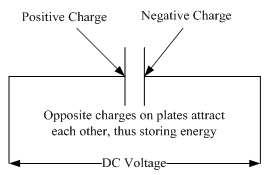
Fig. 2 Principle of the capacitor
As with flywheels, capacitors can provide large energy storage, although they are more normally used in small sizes as components in electronic circuits. The large energy storing capacitors with large plate areas have come to be called super capacitors. The energy stored in a capacitor is given by the equation:
 |
(4) |
where E is the energy stored in Joules. The capacitance C of a capacitor in Farads will be given by the equation:
 |
(5) |
where ε is the is the permittivity of the material between the plates, A is the plate area and d is the separation of the plates. The key to modern super capacitors is that the separation of the plates is so small. The capacitance arises from the formation on the electrode surface of a layer of electrolytic ions (the double layer). They have high surface areas, e.g. 10, 00, 000 m2 kg - −1 , and a 4, 000 F capacitor can be fitted into a container the size of a beer can.
However, the problem with this technology is that the voltage across the capacitor can only be very low, between 1 V to 3 V. The problem with this is clear from Eq. 4; it severely limits the energy that can be stored. In order to store charge at a reasonable voltage many capacitors have to be connected in series. This not only adds cost, it brings other problems too.
If two capacitors C 1 and C 2 are connected in series then it is well known1 that the combined capacitance C is given by the formula:
 |
(6) |
So, for example, two 3 F capacitors in series will have a combined capacitance of 1.5F. Putting capacitors in series reduces the capacitance. Now, the energy stored increases as the voltage squared , so it does result in more energy stored, but not as much as might be hoped from a simple consideration of equation 5 .
Another major problem with putting capacitors in series is that of charge equalization. In a string of capacitors in series the charge on each one should be the same, as the same current flows through the series circuit. However, the problem is that there will be a certain amount of self-discharge in each one, due to the fact that the insulation between the plates of the capacitors will not be perfect. Obviously, this self-discharge will not be equal in all the capacitors; life is not like that! The problem then is that there may be a relative charge build-up on some of the capacitors, and this will result in a higher voltage on those capacitors. It is certain that unless something is done about this, the voltage on some of the capacitors will exceed the maximum of 3 V, irrevocably damaging the capacitor.
This problem of voltage difference will also be exacerbated by the fact that the capacitance of the capacitors will vary slightly, and this will affect the voltage. From Eq. 3 can see that capacitors with the same charge and different capacitances will have different voltages.