Lithium Batteries
Since the late 1980s rechargeable lithium cells have come onto the market. They offer greatly increased energy density in comparison with other rechargeable batteries, though at greatly increased cost. It is a well-established feature of the most expensive laptop computers and mobile phones that lithium rechargeable batteries are specified, rather than the lower cost NiCad or NiHM cells that we have been considering earlier.
The lithium batteries are of following types:
• Lithium polymer batteries
• Lithium ion batteries
In the following subsections each of the above two battery types are described.
The lithium polymer battery
The lithium polymer battery uses lithium metal for the negative electrode and a transition metal intercalation oxide for the positive. In the resulting chemical reaction the lithium combines with the metal oxide to form a lithium metal oxide and release energy. When the battery is recharged the chemical reaction is reversed. The lithium is thus both a reactant and the mobile ion that moves through the electrolyte. The overall chemical reaction is:
 |
(5) |
The lithium ion battery
The lithium ion battery was introduced in the early 1990s and it uses a lithiated transition metal intercalation oxide for the positive electrode and lithiated carbon for the negative electrode. The electrolyte is either a liquid organic solution or a solid polymer. Electrical energy is obtained from the combination of the lithium carbon and the lithium metal oxide to form carbon and lithium metal oxide. The overall chemical reaction for the battery is:
 |
...........................................................(6) |
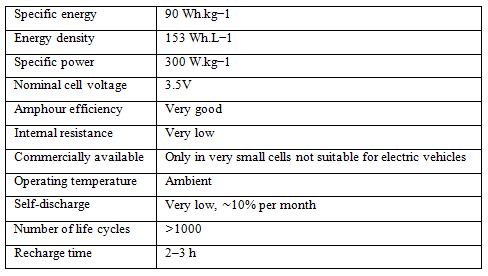
The essential features of the battery are shown in Table II. An important point about lithium ion batteries is that accurate control of voltage is needed when charging lithium cells. If it is slightly too high it can damage the battery, and if too low the battery will be insufficiently charged. Suitable commercial chargers are being developed along with the battery.
.......................................Table II Nominal battery parameters for lithium ion batteries.
........................
Metal Air Batteries
The metal air batteries represent an entirely different development, in the sense that the batteries cannot be recharged simply by reversing the current. Instead the spent metal electrodes must be replaced by new ones. The metal electrodes can thus be considered as a kind of fuel. The spent fuel is then sent to a reprocessing plant where it will be turned into new ‘fuel'. The battery electrolyte will also normally need to be replaced.
The aluminium air battery
The basic chemical reaction of the aluminium air battery is essentially simple. Aluminium is combined with oxygen from the air and water to form aluminium hydroxide, releasing electrical energy in the process. The reaction is irreversible. The overall chemical reaction is:
 |
................................................(7) |