Fundamentals of Regenerative Braking
The topics covered in this chapter are as follows:
• Introduction.
• Energy Consumption in Braking
• Braking Power and Energy on Front and Rear Wheels
Introduction
The electric motors in EVs and HEVs can be controlled to operate as generators to convert the kinetic or potential energy of the vehicle mass into electric energy that can be stored in the energy storage and reused. A successfully designed braking system for a vehicle must always meet two distinct demands:
• In emergency braking, the braking system must bring the vehicle to rest in the shortest possible distance.
• The braking system must maintain control over the vehicle's direction, which requires braking force to be distributed equally on all the wheels.
Energy Consumption in Braking
A significant amount of energy is consumed by braking. Braking a 1500 kg vehicle from 100 km/h to zero speed consumes about 0.16 kWh of energy (0.5 x Mv x V2) in a few tens of meters. If this amount of energy is consumed in coasting by only overcoming the drags (rolling resistance and aerodynamic drag) without braking, the vehicle will travel about 2 km, as shown in Figure 1. When vehicles are driving with a stop-and-go pattern in urban areas, a significant amount of energy is consumed by frequent braking, which results in high fuel consumption.
The braking energy in typical urban areas may reach up to more than 25% of the total traction energy. In large cities, such as New York, it may reach up to 70%. It is concluded that effective regenerative braking can significantly improve the fuel economy of EVs and HEVs.
Braking Power and Energy on Front and Rear Wheels
Braking power and braking energy consumed by the front and rear wheels are closely related to the braking forces on the front and rear wheels. A full understanding of the braking force, braking power, and braking energy consumed by the front and rear wheels in typical drive cycles is helpful in the design of regenerative braking systems.
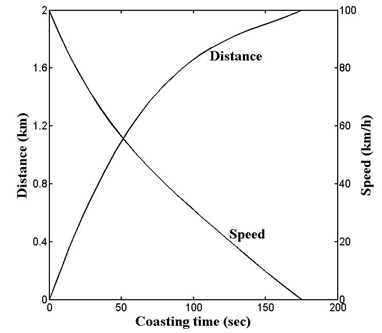
Figure 1: Coasting time, Speed and Distance [1]