The utmost important requirement in control system design is the stability. We would revisit some of the definitions related to stability of a system.
1. Revisiting the basics Let us consider the following system.
 |
(1) |
where  ,
,  ,
,  .
.
Zero State Response: The output response of system (1) that is due to the input only (initial states are zero) is called zero state response.
Zero Input Response: The output response of system (1) that is driven by the initial states only (in absence of any external input) is called zero input response.
BIBO Stability: If for any bounded input u(k) , the output y(k) is also bounded, then the system is said to be BIBO stable.
Bounded Input Bounded State Stability: If for any bounded input u(k), the states are also bounded, then the system is said to be Bounded Input Bounded State stable.
L2 Norm: L2 norm of a state vector x(k) is defined as ![$\displaystyle \vert\vert \boldsymbol{x}(k) \vert\vert _2 = \left [ \sum_{i=1}^n x_i^2(k) \right ]^{\frac{1}{2}} $](images/img13.png)
x(k) is said to be bounded if 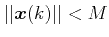 for all k where M is finite.
Zero Input or Internal Stability: If the zero input response of a system subject to a finite initial condition is bounded and reaches zero as k → ∞, then the system is said to be internally stable.
The above condition can be formulated as
 |
|||
 |
The above conditions are also requirements for asymptotic stability .
To ensure all possible stability for an LTI system, the only requirement is that the roots of the characteristic equations are inside the unit circle.