Pole zero map of the uncompensated system is shown in Figure 3. Sum of angle contributions at the desired pole is 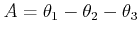 , where
  is the angle by the zero,
  , and
, and  and
and  are the angles contributed by the two poles, 0.82 and 1 respectively.
From the pole zero map as shown in Figure 3, the angles can be calculated as  ,
,  and
and  .
.
Net angle contribution is  . But from angle criterion a point will lie on root locus if the total angle contribution at that point is
  . Angle deficiency is
Controller pulse transfer function must provide an angle of 66.5°. Thus we need a Lead Compensator. Let us consider the following compensator.
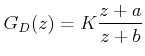 |
If we place controller zero at z = 0.82 to cancel the pole there, we can avoid some of the calculations involved in the design. Then the controller pole should provide an angle of  .
.
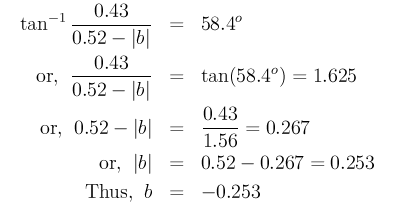
Once we know the required angle contribution of the controller pole, we can easily calculate the pole location as follows.
The pole location is already assumed at  . Since the required angle is greater than
  we can easily say that the pole must lie on the right half of the unit circle. Thus b should be negative. To satisfy angle criterion,
The controller is then written as 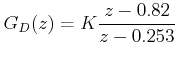 . The root locus of the compensated system (with controller) is shown in Figure 4.
![\includegraphics[width=12cm]{m5l2rl2.eps}](images/img74.png) |
Figure 4: Root locus of the compensated system