Since the amount of loading changes with time, the amount of series compensation may be varied by bypassing (shorting out) these capacitors when not necessary.
Normally a capacitor can allow for short duration over-rating for a few seconds. This allows insertion of larger capacitive reactance into a line for a short time in order to improve angular stability.
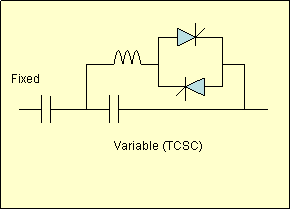
Alternatively, they may be controlled using power electronic controllers. For example, a TCR (discussed in the section on voltage control), may be connected in parallel to the series capacitor and its effective reactance may be controlled by controlling the firing angle delay. This device is called a Thyristor Controlled Series Compensator (TCSC). |