| An important feature of interconnected AC systems is that power flow control through specific control paths is often quite difficult. This is because power flows in these paths as per Kirchhoff laws: the line parameters, topology of the network, generation and load location determine the value of flows. The power flows are not directly dependent on transmission line ownership, contracts, thermal limits or losses!
Inability to control power flows may result in situations wherein, some paths may be lightly loaded and some overloaded (to understand what one means by loadability see the discussion on line loadability in module 2).
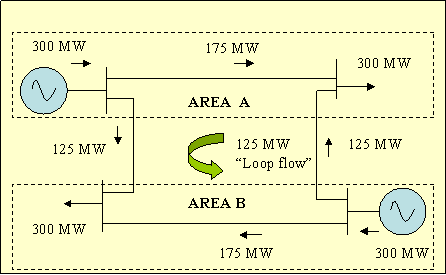
The figure given on the right demonstrates a possible scenario wherein there is power flow in interconnecting tie lines of the two areas although each of them are individually self-sufficient. Thus the tie lines are unnecessarily loaded. This may be a problem if the capacity of the tie lines is limited and one actually wishes to transfer power from one area to another. This is because a part of the line capacities are utilized due to the undesired "loop flow".
|
|
Tie line power flow control by AGC was discussed in the previous module. While cumulative power exchange between the two areas through both tie lines may be controlled by adjusting the generated power in areas A and B, independent power flow control in each individual line connecting the 2 areas is not possible by generation control alone. In the above figure, cumulative power flow in the two tie lines is zero. It can be changed by reducing generated power in one area and increasing in another. However, the individual power in each line cannot be controlled in this fashion and depends on line parameters and Kirchoff's laws.
Therefore, special measures have to be taken in order to control power flow through individual transmission paths. Some of these are considered in the following lectures.
|