While the major means of control of reactive power and voltage is via the excitation systems of synchronous generators, devices may be deployed in a transmission network to maintain a good voltage profile in the system.
Shunt connected devices like shunt capacitors or inductors or synchronous condensers can be used for reactive power control. Shunt Capacitors/Inductors may be fixed or switched (using circuit breakers). Vernier or smooth control of reactive power is also possible by varying effective susceptance characteristics, by use of power electronic devices. As an example let us consider a "Static Var Compensator (SVC) " which employs thyristors. An SVC is a parallel combination of switched or switched capacitors and a Thyristor Controlled Reactor (TCR).
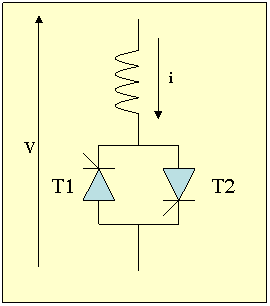
The basic principle of operation of a TCR (see figure on the right) is as follows:
A reactor is connected in series with a back-to-back connected pair of thyristors. The thyristor does not conduct if gate pulses are not provided. In such a case, the effective susceptance is zero. |