Many control systems are depicted as transfer function block diagrams. Transfer function representations are obtained by taking the Laplace transformation of all the variables and obtaining relationships between them. For example, the circuit equation of the R-L circuit given by:
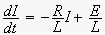
can be written down as: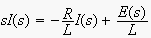 by taking the Laplace Transforms of the variables. The "transfer function" between I(s) and E(s) is given by: by taking the Laplace Transforms of the variables. The "transfer function" between I(s) and E(s) is given by:
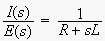
Note here that if is the laplace transform of is the laplace transform of  , then , then  is the laplace transform of is the laplace transform of  . .
The block diagram equivalent (this is not unique) using the transformed variables, of various transfer functions are shown in the figures below:
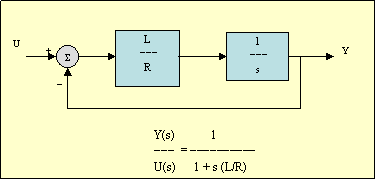
1. A first order transfer function. Steady state gain =1
|
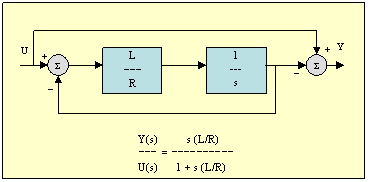
2. A "washout" transfer function. Steady state gain = 0 |
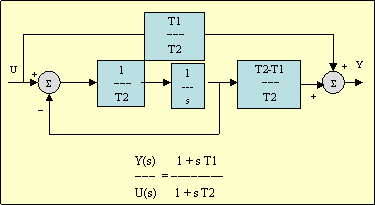
3. A lead (if T1>T2) or lag (if (T2<T1) function.
Steady state gain = 1
|
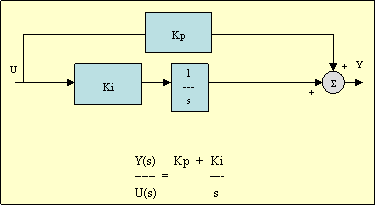
4. A Proportional-Integral Controller. Steady state gain = infinity
|
Steady state (or "DC") gain of a transfer function is obtained by subsituting putting s=0 in the transfer function. |


