We saw in the previous slide that a feedback system can be used to quickly perform the task of weighing 1 kg of rice.It was a manual feedback which involved a human being as the controller and actuator. While a controller decides on what control actions are to be taken based on the feedback obtained by a sensor, an actuator is a device that converts the command of a controller into appropriate actions.
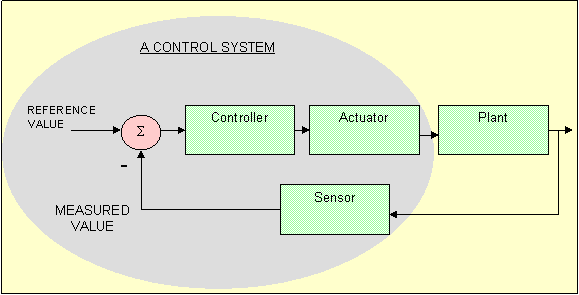
In an automatic feedback controller, the controller actions are decided by some mathematical function which is implemented by a computer or some electronic devices. The nature of mathematical function is decided based on the static and dynamic characteristics of the plant itself.
The main aim of the control system above is to ensure that the steady state value of the variable is equal to the reference value. This kind of a control system is referred to as a regulator. Note: some control systems do not necessarily have a steady state regulation objective, but use feedback to enhance the stability of a plant.
Note that an automatic controller (which is a mathematical function), if designed improperly may worsen the stability of the system. For example, in the rice weighing control system, if the grocer over-reacts to a small imbalance shown by the weighing machine, and pours in (removes) a lot of rice into (from) the weighing pan, then he may be caught in an endless cycle of removal and pouring in rice. This is an unstable situation. Therefore the controller actions should be designed with care.
Example : Suppose we wish to regulate the current in an R-L circuit by controlling the input voltage:
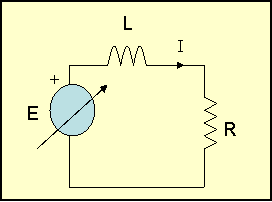 |
The equation describing the "plant" is : 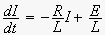 . .
If we wish to get a current  in steady state, then we can set the input voltage to be in steady state, then we can set the input voltage to be  . If we do this the transient response if such a voltage is applied to the circuit, assuming initial current is zero is: . If we do this the transient response if such a voltage is applied to the circuit, assuming initial current is zero is:
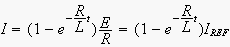
This kind of control is "open loop" and does not require continuous feedback of the current. However, the main problem is that one should know R accurately and also that the transient response is determined by R and L values -- it cannot be modified. |
|


