| |
Let us now re-look, the case of a stable power swing. The resulting movement of apparent impedance seen by relay on the R-X plane may encroach Z2 or Z3 of a relay. If the swing stays inside the zone for long enough time, then the relay will issue a trip command. This is also not desirable. Hence, even under stable swings, the distance relays have to be blocked from tripping.
To conclude this discussion, it is not desirable for distance relay to trip on power swing whether the swing is stable or not. This implies that distance relay should be equipped with swing detection and blocking mechanism. This aspect is elaborated in this lecture. |
| |
The basic idea in detecting a power swing is that change in apparent impedance seen by relay  due to fault occurrence is instantaneous. In contrast, the change in due to fault occurrence is instantaneous. In contrast, the change in  due to power swing is a slow process limited by inertia of generators. Thus, this time discrimination can be used to distinguish swings from faults. due to power swing is a slow process limited by inertia of generators. Thus, this time discrimination can be used to distinguish swings from faults. |
| |
Out-of-Step Blocking Relays |
| |
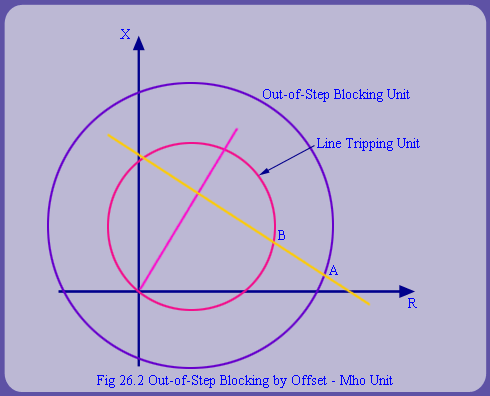  |
Based upon the above principle, fig 26.2 shows out of step blocking scheme with an offset Mho unit.
The out-of-step blocking unit is similar to the Mho unit. It is a circle concentric to mho - tripping characteristic but it has a larger radius. In other words, the tripping characteristic is embedded inside the blocking unit. This ascertains that any power swing which enters tripping will first enter the out-of-step blocking characteristic. For the swing locus, shown in fig 26.2, this happens at point A. After a short while, it reaches the tripping characteristics and enters tripping region at point B. |

