| |
We have so far seen that power swings can be classified as either stable or unstable. Basically, a relay which is expected to issue trip decision on a fault should not pick up on a swing (either stable or unstable). When a power swing is a consequence of stable disturbance, unwanted line tripping can aggravate disturbance and lead to instability. On the other hand, when the power swing is a consequence of disturbance, classified as unstable, then interconnected operation of the system is simply not possible.
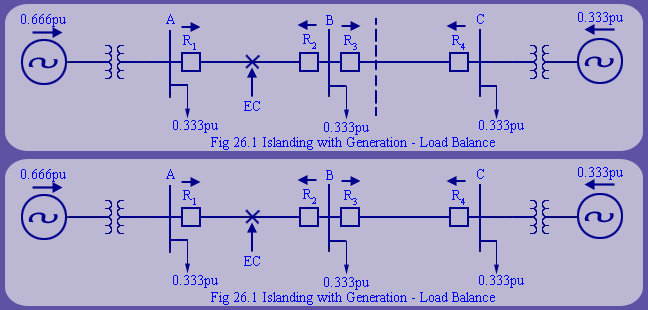
This implies that the system has to be split into multiple islands each of which can have independent existence i.e. each island can maintain synchronism of generators. Now to achieve stable operation in each island, generator load balance has to be ascertained. If an island has excess generation, it should be shelved and similarly if an island has excess load then load shedding is required. Load shedding is usually initiated by underfrequency relays, as excess load tends to pull the frequency down. However, to minimize the loss of service to consumers, the boundary of islands has to be selected carefully. To illustrate this point, consider a simple two area system as shown in fig 26.1. |
| |
Now consequent to a disturbance, let the system be unstable and let the location of electrical center be on line AB. Recall that at the electrical center, voltage zero point is created when the two generators are out of step. Alternatively, electrical center appears when the power swing intersects the transmission line characteristics. This implies that relays located at the two ends of the transmission line, perceive the out of step condition as a bolted three phase fault on the transmission line. Consequently, relays R1 and R2 will issue a trip decision, thereby islanding the system. Now, the generator at A (PG = 0.666pu) islands with a load of 0.333pu and generator at B (PG= 0.333pu) islands with a load of 0.666pu. The resulting loss of load is 0.333pu in island B and loss of generation in island A is 0.333pu.
However, if we had islanded the system by tripping line BC then an ideal solution of zero load or generation shedding would have been achieved. This suggests that during unstable swings, we should block the relays from operation. Consequently, more selective tripping can be initiated to achieve the desirable islands. We now, arrive at a thumb rule that under out of step condition, distance relays should be blocked from operation on swings. |