| |
Determination of power swing locus (contd..) |
| |
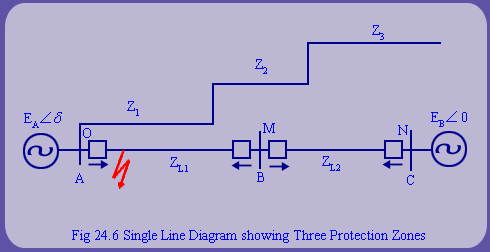 |
Now consider a double-end-fed transmission line with three stepped distance protection scheme having Z1 , Z2 and Z3 protection zones as shown in fig 24.6. The mho relays are used and characteristics are plotted on R-X plane as shown in fig 24.7. Swing impedance trajectory is also overlapped on relay characteristics for a simple case of equal end voltages (i.e. k = 1) and it is perpendicular to line AB. |
| |
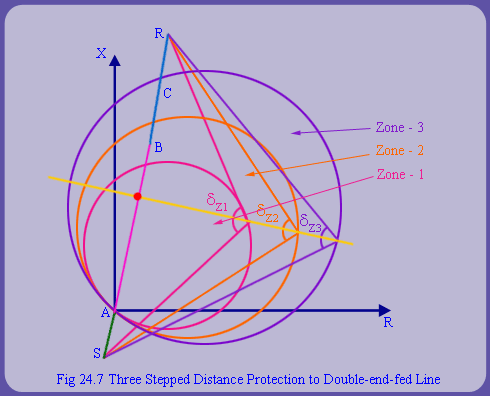 |
From fig 24.6,  , ,  and and  are rotor angles when swing just enters the zone Z1 , Z2 and Z3 respectively and it can be obtained from the intersection of swing trajectory with the relay characteristics. Recall that are rotor angles when swing just enters the zone Z1 , Z2 and Z3 respectively and it can be obtained from the intersection of swing trajectory with the relay characteristics. Recall that  is the maximum rotor angle for stable power swing. Following inferences can be drawn. is the maximum rotor angle for stable power swing. Following inferences can be drawn.
If  , then swing will not enter the relay characteristics. , then swing will not enter the relay characteristics.
If 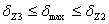 , swing will enter in zone Z3. If it stays in zone - Z3 for larger interval than its TDS, then the relay will trip the line. , swing will enter in zone Z3. If it stays in zone - Z3 for larger interval than its TDS, then the relay will trip the line. |
| |
If 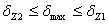 , swing will enter in both the zones Z2 and Z3. If it stays in zone 2, for a larger interval than its TDS, then the relay will trip on Z2. Typically, TDS of Z2 is less than TDS of Z3. , swing will enter in both the zones Z2 and Z3. If it stays in zone 2, for a larger interval than its TDS, then the relay will trip on Z2. Typically, TDS of Z2 is less than TDS of Z3.
If  , swing will enter in the zones Z1, Z2 and Z3 and operate zone 1 protection without any intentional delay. , swing will enter in the zones Z1, Z2 and Z3 and operate zone 1 protection without any intentional delay.
So far, we have discussed power swings for a 2-machine system. Evaluation of power swings on a multimachine system requires usage of transient stability program. By using transient stability program, during post fault the relay end node voltage and line currents can be monitored and then the swing trajectory can be traced on a impedance plane. |


