In this lecture, we will introduce the concept of power swings. It will be shown that the post fault power swings may encroach the relay characteristics. This can lead to nuisance tripping of distance relays which can sacrifice the system security.
Analysis of Two Area System
Power swings refer to oscillation in active and reactive power flows on a transmission line consequent to a large disturbance like a fault. The oscillation in the apparent power and bus voltages is seen by the relay as an impedance swing on the R-X plane. If the impedance trajectory enters a relay zone and if stays there for sufficiently long time, then the relay will issue a trip decision on power swing. Tripping on power swings is not desirable. We now investigate this phenomenon and then discuss remedial measures.
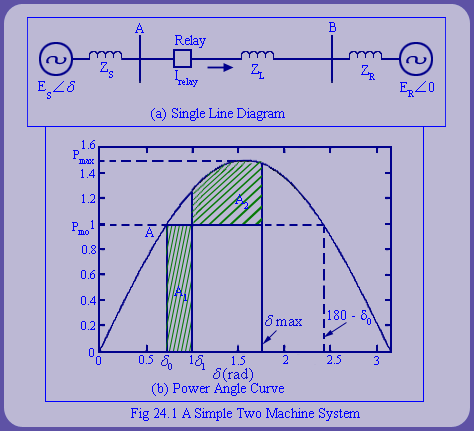
Let us consider a simple two machines system connected by a transmission line of impedance ZL as shown in fig 24.1(a). ES and ER are the generator voltages at two ends and we assume that the system is purely reactive.
The voltage ES leads ER by an angle
so that power flows from A to B during steady state. The relay under consideration is located at bus A end. The power angle curve is shown in fig 24.1(b) . The system is operating at initial steady operating point A with Pmo as output power and
as initial rotor angle.
From the power angle curve, initial rotor angle, is given by:


 so that power flows from A to B during steady state. The relay under consideration is located at bus A end. The power angle curve is shown in fig 24.1(b) . The system is operating at initial steady operating point A with Pmo as output power and
 as initial rotor angle.
 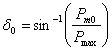 (1)
(1)

