| 5.3 |
Classification of CTs |
| 5.3.1 |
ANSI / IEEE classification |
| |
ANSI/IEEE standards classify CTs into two types: |
 |
Class T CT |
|
Class C CT |
| 5.3.1.1 |
Class T CTs
|
 |
|
|
| |
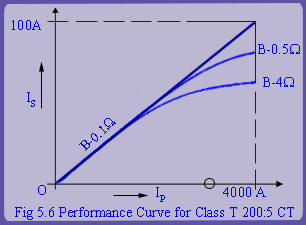 |
Typically, a class T CT is a wound type CT with one or more primary turns wound on a core. It is associated with high leakage flux in the core. Because of this, the only way to determine it's performance is by test. In other words, standardized performance curves cannot be used with this types of CTs.
Figure 5.6 shows one such experimentally calibrated curve for a CT. The letter ‘B' indicates the burden in ohms to which the CT is subjected. It is seen that when burden is less than say 0.1 ohms, CT meets the linear performance criterion. However, as the burden increases to 0.5 ohms, the corresponding linearity criteria is not met till the end. At 4 ohms burden, there is significant deviation from the linear response. A general rule of thumb is that, one should try to keep the CT burden as low as possible. |
| |
Ratio Error: CT performance is usually gauged from the ratio error. The ratio error is the percentage deviation in the current magnitude in the secondary from the desired value. In other words, if the current measured in the secondary is Is, true or actual value is Ip/N, where N is nominal ratio (e.g. N for a 100:5 CT is 20) and Ip is the primary current then ratio error is given by
 . When the CT is not saturated ratio error
is a consequence of magnetizing current IE since  . Therefore, % ratio error is equal to  .
When the CT is saturated, coupling between primary and secondary is reduced. Hence large ratio errors are expected in saturation. The current in the secondary is also phase shifted. For measurement grade CTs, there are strict performance requirements on phase angle errors also. Error in phase angle measurement affects power factor calculation and ultimately real and reactive power measurements. It is expected that the ratio error for protection grade CTs will be maintained within  . |
| |
|
|

