The function in minterm canonical form is as follows:.

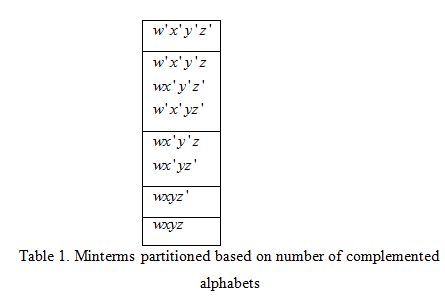
Now we construct a table (Table 1), where the minterms appearing in the canonical form are entered. The column is divided into four parts based on number of complemented letters of the terms. The first group consists of minterms with no un-complemented literals. In general, some groups may be empty. So, for consensus, we to need to compare terms of immediately successive groups. It may be noted that we need not consider the minterms in the immediately preceding group, because this would only cause us to repeat comparisons.
In the example, if we compare the term from the first row (  ) with the top most term of second row (
 ), their consensus term is
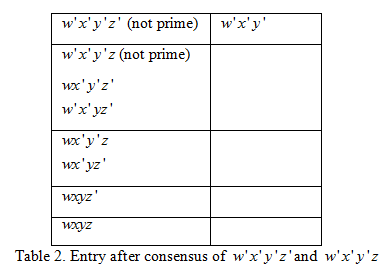
  . Both and are marked as non-prime because there exists another implicant that contains them. A second column is created in the table where in the first row the consensus term is placed; this is shown in Table 2.
The same process is repeated for all terms (immediately successive group) of Table 1. Table 3 illustrates the situation after consensus is performed on all terms of Table 1.
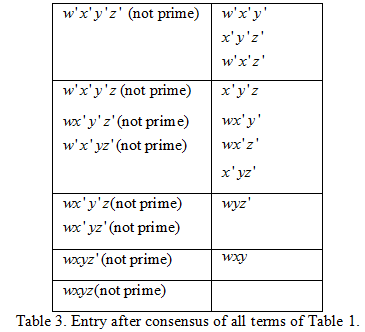
It may be noted that the second column is also divided based on the number of complemented alphabets in the terms.
As in the case of column 1 of Table 1, the same procedure is repeated for elements of column 2 of Table 3; this generates column 3 as shown in Table 4.
It may be noted that fourth column cannot be created as no terms of column 3 (Table 4) has consensus. So here, we have four prime implicants as 