|
|
- Measurement modes : Variety of measurement modes are available with TS such as precise, accurate, and fast tracking, etc. These modes are result of a combination of accuracy and speed. Depending up on accuracy levels required and measurement times, the surveyor can choose an appropriate measurement mode.
- Automatic target recognition (ATR): This facility ensures that the instrument will lock on to the active target (by using RMT: remote measurement target). The instrument receives coded signal by IR diode on the RMT. In this mode, the instrument automatically follows the reflector after the first measurement. The telescope is pointed in the general direction of the target, and the ATR module completes the fine pointing with excellent precision and minimum measuring time as there is no need to focus. It can also be used on a moving reflector. A single key touch records all data without interrupting the tracking process. Omni-direction (360o) prisms reflector are used for short distances which are always aligned automatically ensuring high accuracy (Figure 3.7). For longer distances directional active targets are available. The ATR mode also allows operation in darkness.
- Reflectorless or direct reflex measurement: Distance measurement without prism is also available on many instruments, typically using two different coaxial red laser systems. One laser is invisible and is used to measure long distances (6 km to a single reflector), the other is visible, does not require a reflector, and has a limited range of about 200 m. A single key stroke allows one to alternate between the visible or invisible laser. With Trimble 5600 DR 200+, distances of up to 500 m have been recorded (Figure 3.7). The reflectorless measurements are useful for surveying the facades of buildings, tunnel profiling, cooling tower profiling, bridge components, and dam faces - indeed any situation which is difficult or impossible to access directly. The extremely narrow laser used clearly defines the target points.
|
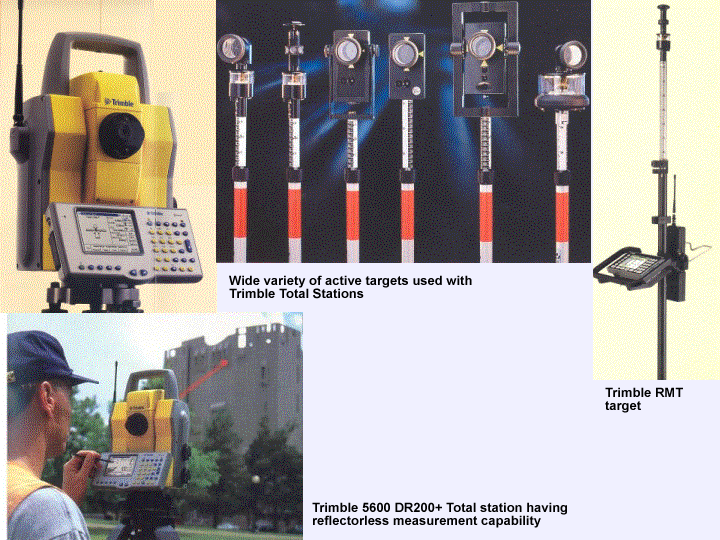
Figure 3.7 Different types of active targets and reflectorless TS |
- Remote control systems : This arrangement allows truly one-person surveying capability. It is particularly useful for mass point surveys, cadastral surveys, staking out and machine guidance. Control of operation is transferred to the surveyor at the survey point where all functions can be called up. The unit generally employs a radio communication between TS and the prism. The control unit, battery, antenna and radio modem are integrated to allow full control over instrument and its operation. Figure 3.7 shows a Trimble system with one radio antenna for communication with RMT.
|
|


