Module 1 : Modern Surveying Equipment
 Lecture 3 : Total Station (TS)
Salient features of modern TS

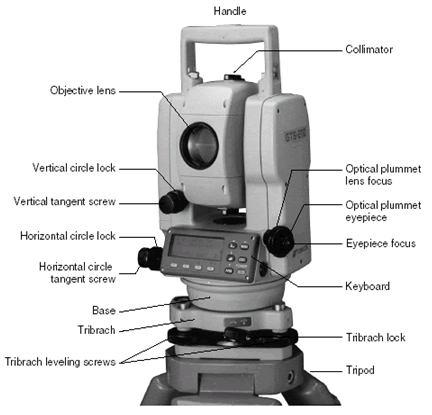
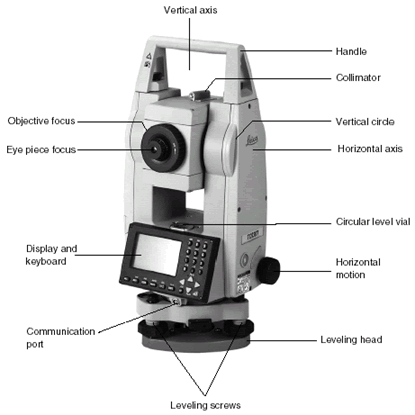
TS is a fully integrated equipment that captures all the spatial data necessary for a three-dimensional position fix. The angles and distances are displayed on a digital readout and can be recorded at the press of a button. Various components of a typical TS are shown in Figure 3.3 and are described below:



Click image for a larger view


Click image for a larger view


Figure 3.3 Parts of Total Station (a) Eye Piece end (b) Objective end (Wolf and Ghilani, 2002)

A typical TS has the following characteristics:

  • Graphic display: All commands for survey operation as well as results are displayed on graphic LCD using alphanumeric keyboard. Using built in software with menu and edit facilities, they automatically reduce angular and linear observations to three dimensional coordinates of the vector observed. Detachable control units are available on particular instruments
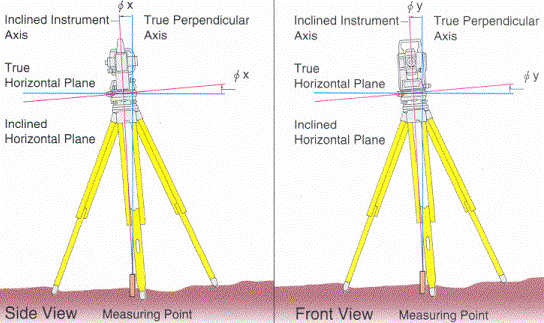
  • Dual axis compensation : The dual axis tilt sensor monitors any inclination of the standing axis in both X- and Y-directions. These tilt sensors generally have range of 3'. Consequently horizontal and vertical angle readings are free from error due to any deviation of the standing axis from the perpendicular (Figure 3.4). The horizontal and vertical angles are automatically corrected, thus permitting single-face observations without loss of accuracy.
Figure 3.4 Principle of dual axis compensator (Sokkia TS instruments)
  • Levelling and centering: A few TS have electronic display for levelling operation enabling rapid and precise leveling. The electronic levelling also eliminates errors caused by direct sunlight on plate bubbles. Laser plummet are replacing the optical plummet. A clearly visible laser dot is projected on to the ground that helps in quick and convenient centering of the instrument.