Human element causes lot of uncertainty when dealing with the transportation engineering related problems. Specifically this is significant when dealing with traffic engineering and transportation planning related problems. As shown in Figure 1.9, there is a huge variability in the number of vehicles crossing a road section in unit time period. Given the same conditions the same driver with the same vehicle may maintain different speeds at two different time instances (Figure 1.11 shows the relative frequency diagram of the vehicular speeds). Same is true with the gap maintaining behavior with respect to the front vehicles (Figure 1.10 shows the frequency histogram of the time headways), and the overtaking behavior, to quote a few situations. Knowledge about the vehicle arrivals plays important role in formulating the traffic management schemes. But this is a variable process and one may have to settle for highly probabilistic process and the design of the traffic control scheme has to be carried out on this basis.
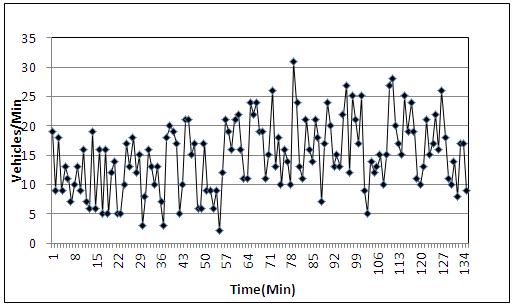
Figure 1.9: Time series data of vehicular flow observed at a road section
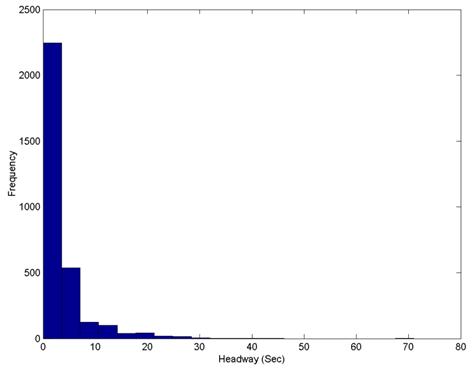
Figure 1.10: Headway frequencies observed on a single lane road
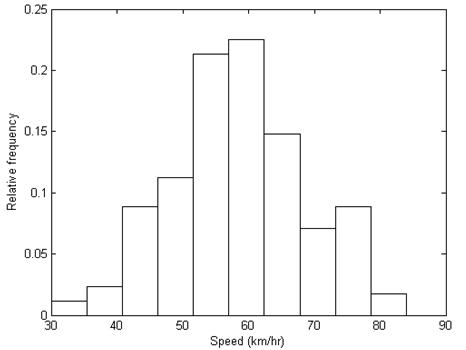
Figure 1.11: Relative frequency histogram of the free flow speed data of a particular vehicle type
Under similar circumstances a person may choose different modes for his intercity movement. Normally this is attributed to the inherent randomness in the human being but there is an element of chance that this behavior might have resulted from our inability to understand the factors behind the mode choice. Knowledge of statistics is very important when dealing with transportation planning where policy makers/researchers use sample data in formulating the policies meant for future. Collecting the sample data is one of costliest processes involved in the transportation planning process. Mistakes committed at this stage, due to lack of statistics knowledge, renders the entire planning process invalid.
Scope and objectives of this course
To begin with, the basic concepts of probability and statistics are discussed. Keeping in view the problems encountered in various branches of civil engineering, application oriented examples are provided along with the basic concepts. To make it more relevant to the civil engineering students of both under graduate and post graduate level, examples from all major civil engineering branches are discussed. Wherever possible, experimental data have been utilized in the example problems.