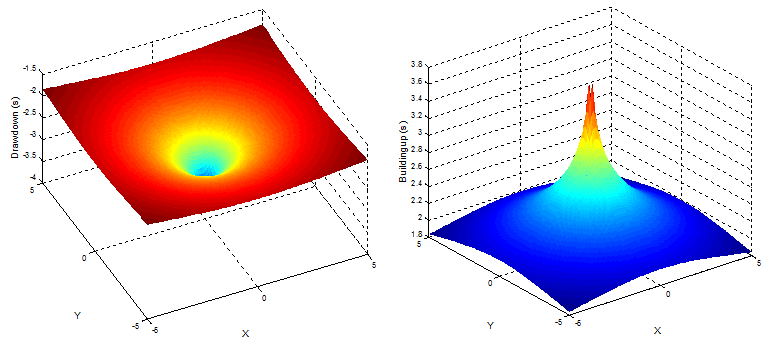
The flow towards a well, situated in homogeneous and isotropic confined or unconfined aquifer is radially symmetric. Fig. 15.1(a) shows the cone of depression caused due to constant pumping through a single well situated at (0,0) in a confined aquifer. Fig. 15.1(b) shows the cone of impression caused due to constant recharge through the well. In case of homogeneous and isotropic medium, the cone of depression or cone of impression is radially symmetrical. The governing equation derived earlier in Cartesian coordinate system for confined and unconfined aquifer can also be derived for radial flow in an aquifer. In this lecture, we will derive the governing flow equation for confined and unconfined aquifer in polar coordinate system. The main objective of this conversion is to make the 2D flow problem a 1D flow problem. The resulting 1D problem will be simpler to solve.
-
Fig. 15.1 (a) Cone of depression (b) Cone of impression
Confined aquifer
-
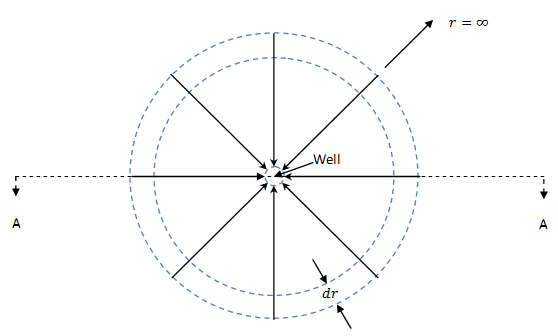
(a) Radial flow to a well
-
-
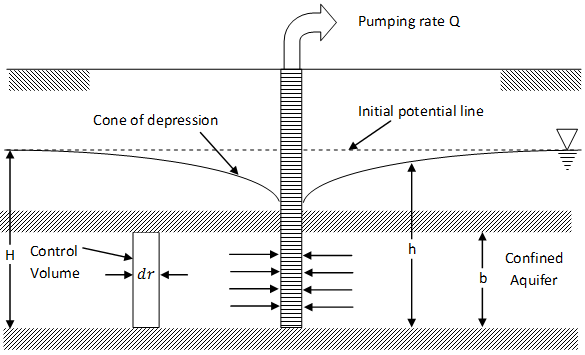
(b) Section A-A in case of confined aquifer
-
Fig. 15.2: A confiner aquifer
Let us consider a case of radial flow to a single well (Fig.15.2) in a confined aquifer. The Fig. 15.2 (a) shows the radial flow towards a well and a control volume of thickness dr. The Fig. 15.2 (b) shows the vertical section AA of the aquifer along with cone of depression. The aquifer is homogeneous and isotropic and have constant thickness of b. The hydraulic conductivity of the aquifer is K. The pumping rate (Q) of the aquifer is constant and the well diameter is infinitesimally small. The well is fully penetrated into the entire thickness of the confined aquifer. This is necessary to make the flow essentially horizontal. The potential head in the aquifer prior to pumping is uniform throughout the aquifer.