In case of homogeneous isotropic aquifer (Kx = Ky = Kz = K)
|
(12.18)
|

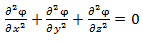
For steady state condition  the equation becomes
|
(12.20) |
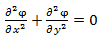
For 2-D steady state condition, it will be
|
(12.21) |
If we have distributed sources and sinks of N(x,y,z,t) in the aquifer, the flow equation becomes
|
(12.22) |

Boundary and initial conditions
For solving the steady state flow equation as derived above, appropriate
boundary conditions are needed.
It is one of the required components of the mathematical model. On the other hand, for solving transient flow equation, appropriate initial condition is also required. Boundary conditions are generally three types. They are Dirichlet boundary condition, Neumann boundary condition and mixed boundary condition.
Dirchlet boundary condition
In case of Dirichlet boundary condition, prescribe value of the variable h(x,y,z,t) is specified at the boundary of the problem domain. This is also known as type I boundary condition. The head may be constant or may vary in space or in time.
Neumann boundary condition
In case of Neumann boundary condition, the gradient of the variable ( ) is specified at the boundary of the problem domain. Here, n is the direction, x, y, and z. One of the most frequently use Neumann boundary condition is the no flow boundary condition, i.e. = 0 at the boundary.
As discussed, in case of Neumann boundary condition, we have
|
(12.23) |

Where, C1 is constant
|
(12.24) |
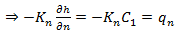
Where qn is the Darcy's flux in the nth direction. As such in case of Neumann boundary condition, we can also specify the Darcy's flux at the boundary instead of the gradient of the variable. The Neumann boundary condition is also knows as Type II boundary condition.