When water containing dissolved contaminants (reactive) comes in contact with soil, the total mass of the contaminant will partition between solution and the soil. Concentration of contaminant sorbed on to the soil solids is given by
Cs = (Ci-Ce).(V/Ms) |
3.12 |
Where Ci is the initial concentration of contaminant in pore water, Ce is the concentration of contaminant in pore water at equilibrium sorption reaction, Cs is the concentration of contaminant sorbed on soil mass, V is the volume of pore water which has interacted with Ms mass of soil. V/Ms is known as liquid to solid ratio.
For water flowing at a sufficiently low pace, the sorption reaction reaches equilibrium. The equilibrium sorption reaction is mathematically defined by using sorption isotherms. These isotherms define the equilibrium relationship between sorbed concentration on soil and equilibrium concentration present in solution.
Cs = f(Ce) |
3.13 |
The simplest case of sorption can be modelled using linear isotherm represented by Eq. 3.14.
Cs = Kd. Ce |
3.14 |
Kd is the partition coefficient representing the amount of sorption on soil. Such linear isotherms are good approximations for low concentration range. For higher range of concentration, sorption is non-linear. Two commonly used non-linear isotherms are Langmuir isotherm and Freundlich isotherm as represented by Eqs. 3.15 and 3.16, respectively.
|
3.15 |

Cs = Kf. Cne |
3.16 |
Where Sm is the maximum capacity of sorption at all available sorption site (mono layer), b is a constant representing rate of sorption, Kf and n are empirical constants. Once the sorption isotherm are defined for a particular contaminant-soil system, then the solute sorbed on soil for any concentration of solution can be determined.
Sorption characteristics of contaminant-soil system are determined by batch test procedure (ASTM D 4646). The liquid to solid ratio and required pH for the batch sorption test is decided. Based on the expected range in the field, the range of concentration of solution is finalized. The soil is mixed with solution in the chosen liquid to solid ratio and shaken for 16 hrs using a mechanical shaker. The solution is then filtered and analyzed for equilibrium concentration (Ce). Knowing the initial concentration, the sorbed mass (Cs) can be determined based on Eq. 3.12. Plot the results of Cs vs. Ce and use appropriate sorption isotherm to define the trend mathematically.
Governing differential equation for contaminant transport
By considering conservation of mass within small soil volume and summing up the process explained above, the governing differential equation for contaminant transport (Fetter 1992) can be expressed as
|
3.17 |
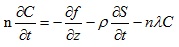
f is the mass flux due to advective-dispersive transport = 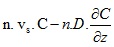 , S is the sorbed concentration of contaminant and equal to Cs (Eq. 3.13), n is the porosity, C is the concentration of pore water at time t and distance z, D is the hydrodynamic dispersion coefficient, ρ is the dry density of soil, λ represent first order decay reaction such as radioactive decay.
Substituting for f, assuming the simplest linear sorption isotherm  and neglecting first order decay Eq. 3.17 can be represented as
|
3.18 |

|
3.19 |
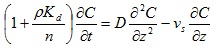
 is termed as retardation coefficient “R” when linear sorption is assumed for contaminant-soil interaction. This assumption is valid for low concentration range of contaminant.