3.4.3.2 Design philosophy of compacted liner
For the design of compacted liner it is important to understand the governing mechanism of contaminant transport through soil. Knowing the governing mechanism, the appropriate governing differential equation is formulated. The solution of governing equation is used to predict the concentration of contaminant with respect to space and time. Such predictions are used to evaluate whether the thickness of compacted liner (with a specific set of properties) would be able to protect the groundwater aquifer from pollution for the period of design life (which may be as high as 100 years). If not, then the thickness or the material of liner is modified to meet the requirements. To start with, the governing mechanisms of contaminant transport is discussed below:
1) Advection: It is the movement of contaminant along with the flowing water. Seepage velocity
(vs) become important. Movement of contaminant with velocity equal to ground water is termed as plug flow.
Mass flux of contaminant transported by advection is f = n. vs. C = v. C 3.4
Mass flux is defined as the amount of mass transported across a given cross section in unit time. n is the porosity and C is the concentration.
| Total mass flux due to advection | 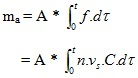 |
3.5 |
ma is the mass of contaminant transported from landfill by advection. A is the cross section area through which contaminant passes. For non-reactive contaminant, contaminant moves with a velocity equal to flow velocity. If velocity is negligible, contaminant movement by advection is minimal.
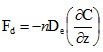
2) Diffusion: It is the process of solute transport from a region of higher concentration to a region of lower concentration. The process is termed as molecular diffusion, Dm, when the solute migrates in pure water. However, diffusion in the porous media is restricted only to pore space and can be expressed by Fick's first and second laws (Rowe et al. 1988), which corresponds to steady (Eq. 3.6) and transient diffusion (Eq. 3.7), respectively.
|
3.6 |
where, 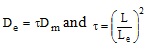
|
3.7 |
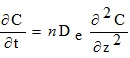
where Fd is the mass flux to diffusion of solute per unit area per unit time, De is the effective diffusion coefficient, Dm is the molecular diffusion coefficient,  is the tortuosity coefficient,
  is termed as concentration gradient, L is the straight line distance of the flow path, Le is the actual distance traveled by the solute through the pore space and z is the distance of solute travel.
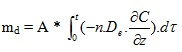
Total mass flux due to steady state diffusion |
3.8 |
Advective-dispersive transport:
Mechanical dispersion (Dmd) occurs when flow velocity is high, sudden variation in flow velocity or due to non-homogeneity in porous media. Dispersion and diffusion process are normally lumped together and known as hydrodynamic dispersion coefficient (D).
| D = (De + Dmd) | 3.9 |
For low permeable soils like clays, De dominates and for high permeable soils like sands Dmd dominates. Dmd is represented as a linear function of velocity as represented by Eq. 3.10.
| Dmd = α.v | 3.10 |
α is known as dispersivity (in m). It is scale dependent and changes with the extent of problem domain.
Total mass flux due to advective-dispersive transport is given by
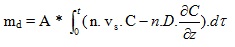 |
3.11 |
Sorption
Sorption process, as discussed in chapter 2, is an important contaminant retention mechanism that slow down or remove the contaminant from flowing pore water there by delaying its presence in groundwater. Therefore, for reactive contaminants, sorption plays an important role in deciding its fate (presence of contaminant with respect to space and time). Sorption is governed by physico-chemical properties of both solute and soil. Many soils can preferentially adsorb some type of contaminants to others.