|
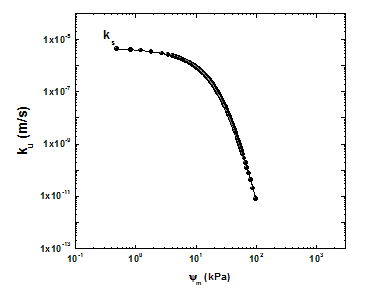
Fig. 2.13 Variation of unsaturated hydraulic conductivity with suction (Malaya 2011) |
The 1-D flow through unsaturated soil can be represented by Darcy’s law expressed in the form of Eq. 2.37 where the flux density q is given by
 |
2.37 |
where q is the flux density or Darcy velocity, H is the total soil water potential, z is the distance in the direction of flow, k(h) is the hydraulic conductivity which is a function of matric suction head.
H = z + h
z is the gravitational head and h is the matric suction head or pressure head in general. In the case of unsaturated state of the soil, pressure head will be matric suction head or negative pressure head.
 is the hydraulic gradient represented by "i" which can also equal to
  .
.
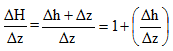
Average i = 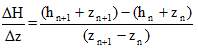
n increases downwards and reference datum is ground surface.
Problem: For a soil, matric potential head is -75 cm and -50 cm at depth 150 cm and 200 cm, respectively. Given  and k = menθ. a= 1000, b = 2, m = 10-12, n = 45, k is in m/s. Determine soil water flux in m/s and flow direction. Distance downward is –ve and reference is ground surface.
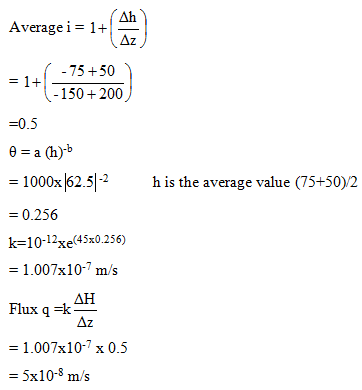
Total potential: at 150 cm = -225 cm and at 200 cm = -250 cm. The flow will take place in the downward direction.
Soil water diffusivity
While dealing with most of the flow problems in hydrology and geoenvironmental engineering, the term soil water diffusivity becomes important. According to Darcy’s law, flow density is defined by Eq. 2.37 which is re-written below:
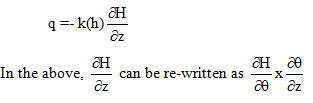
is the inverse of specific water capacity (c) where in H is considered as the suction head.
Therefore the above equation becomes q = 
In the above representation,  is known as soil-water diffusivity (D) and its unit is m2/s.
 |
2.38 |
Eq. 2.38 is identical to Fick’s first law of solute diffusion. Analytical solutions are proposed by researchers for the above differential equation for simple boundary conditions. This equation is suitable for highly unsaturated state of the soil and is not valid of near saturated soil. For nearly saturated soil C approaches zero.