WRCC models and estimation
It is noted that most of the instruments reported above have limited range of suction measurement. Therefore, several empirical or semi-empirical mathematical models have been developed for representing WRCC. The parameters of these models can be obtained by using the limited range of measured suction data. Once the parameters are known, the same can be used for extrapolating or interpolating the results by using the WRCC model. These
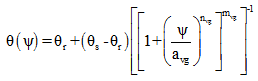
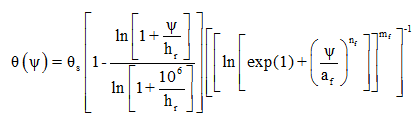
WRCC parameters are important input for many of the mathematical models dealing with unsaturated soils. Two such models which are used widely in the literature are van Genuchten (1980) model and Fredlund and Xing (1994) model represented by Eqs. 2.35 and 2.36, respectively.
 |
2.35 |
 |
2.35 |
where θ(ψ) is the volumetric water content at any suction, ψ; θr is the residual volumetric water content; θs is the volumetric water content at saturation; avg and af are fitting parameters primarily dependent on the air entry value (AEV); nvg and nf are fitting parameters that are dependent on the rate of extraction of water from the soil; mvg and mf are fitting parameters which depend on θr; hr is the suction (in kPa) corresponding to residual state. There are several such simplified and complex models reported in the literature for defining WRCC.
The experimental procedures adopted for determining SWCC are time consuming and cost-intensive. Therefore, attempts have been made by researchers to develop functions (such as pedo transfer functions) for the quick estimation of WRCC without performing extensive suction measurements. In such cases, WRCC is based on soil physical parameters that can be quickly determined in the lab. This indirect approach is less time-consuming, simple, and more economical. However, such estimations can be
soil specific and case-specific and would depend mostly on the data used for developing the procedure.
Therefore, estimated WRCC should be used with caution and only in those cases where suction measurements cannot be performed. For important projects it is always preferable to obtain measured WRCC for the soil. For more details on WRCC estimation, readers are requested to go through the wide range of literature available (Fredlund et al. 1998; Mbagwu and Mbah 1998; Fredlund et al. 2002; Matula et al. 2007; Nimmo et al. 2007; Soil vision 4.10)
Complexity in modelling the behaviour of unsaturated soil
As discussed above, all the properties of unsaturated soil such as seepage, strength, and volume change behaviour are dependent upon the suction existing in the soil. These properties changes when the state of unsaturation changes and suction changes. The state of unsaturation is defined by θ, w or Sr. As against the steady state behaviour in saturated soil, an unsaturated soil therefore exhibit transient behaviour. The
complex behavioural modelling of unsaturated soil is explained with respect to
unsaturated hydraulic conductivity (ku) and flow as an example.
In the case of saturated soil, hydraulic conductivity (ks) remains constant with time. This is mainly due to the fact that all the pores are filled with water. In the case of unsaturated soil there is retention forces (suction) acting on water that would restrict easy movement. Due to this, hydraulic conductivity of unsaturated soil drastically reduces and is essentially a function of water content or suction present in the soil. For a particular soil, ku increases as suction decreases till it approaches ks as shown in Fig. 2.13 (Malaya 2011). This is mainly due to the fact that suction decreases due to the increase in water content which results in the increase in ku. Therefore, it is clear that ku is a function and changes with water content or suction. These functions are highly non-linear and laborious to determine experimentally. Mostly ku functions are estimated indirectly from water-retention characteristic curve (or SWCC), which is relatively easy to determine experimentally.