Unsaturated soil (vadoze zone)
Unsaturated soil or partially saturated soil and its behaviour come under the purview of soil-water interaction problem. The classical soil mechanics deals with a two phase system and the concepts are based on the assumption that soil is fully saturated (solid particles and water) or fully dry (solid particles and air). But this assumption may not be valid for some of the real life situations such as highway and railway embankments, airfields, dams, tunnels, natural slopes, linings and covers of waste containment facilities, back fill of retaining walls, stability of vertical excavations, where in soil is generally unsaturated and becomes a three or multiphase system. Therefore, its behaviour does not comply with the concepts developed for saturated soil medium.
The interaction of solid, water and air phase present in the soil develops a complex energy state resulting in negative pore water pressure known as soil suction. Soil suction is defined as the energy required for extracting unit volume of water from soil (Fredlund and Rahardjo 1993). The suction present in the unsaturated soil makes its behaviour highly transient (varies with time) as compared to the steady state behaviour of saturated soils. Therefore, all constant parameters such as water potential, permeability, strength etc. of saturated soil become a function in unsaturated soil. The study of unsaturated soil behaviour is dependent on the basic relationship between suction and water content (either, gravimetric or volumetric) or saturation. Such a graphical plot as shown in Fig. 2.12 is popularly known as soil-water characteristic curve (SWCC) or water retention characteristic curve (WRCC) in general.
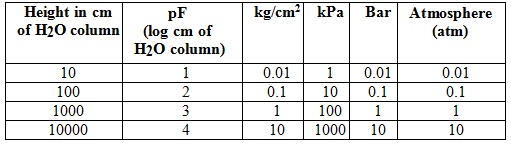
Numerous research works have demonstrated that the WRCC is mandatory for studying the behaviour of unsaturated soil (Fredlund and Rahardjo 1993). For accurate determination of WRCC, the precise measurement of soil suction becomes very important. The major components of soil suction include matric suction (ψm) and osmotic suction (ψo). The sum of these two components is termed as total soil suction (ψ). Please note that ψm and ψo is same as the soil-water potential discussed in the previous section. However, ψ is not same as total water potential since the former constitute only negative water potentials. ψm is due to the adsorptive and capillary force existing in the soil matrix where as ψo is the result of salts or contaminants present in the soil pore-water. In the absence of any contamination, ψm is equal to ψ. The common units for soil suction are kPa, Atm, pF, centibar. The unit pF is defined as the common logarithm of height in centimeters of the water column needed to provide the suction. Table 2.4 summarizes the relationship between different commonly used units of suction.
Table 2.4 Relationship between different units of soil suction |
 |
WRCC obtained by drying and wetting the soil sample is termed as desaturation (desorption) and saturation (adsorption) curve, respectively. A typical drying and wetting WRCCs is presented in Fig. 2.12, which indicates a continuous ‘S’ shaped hysteretic relationship. Due to hysteresis, drying WRCC has higher suction than wetting curve for particular water content. Following are some of the key points that are relevant for WRCC:
- The volumetric water content at saturation, θs, describes the water content at which the soil is completely saturated and typically depicts the initial state for the evaluation of the drying path.
- The air-entry value (AEV), ψa, is the suction at which air enter the largest pore present in the soil sample during a drying process. AEV is less for coarse soil as compared to fine soils.
- Residual water content (θr) is the minimum water content below which there is no appreciable change in θ. Suction corresponding to θr is called residual soil suction, ψr.
- The water-entry value, ψw, on the wetting WRCC, is defined as the matric suction at which the water content of the soil starts to increase significantly during the wetting process.
A fully saturated soil specimen having a volumetric water content of θs desaturates in three stages as depicted in Fig. 2.12. In stage 1 termed as capillary saturation zone extending up to AEV, the soil remains saturated with the pore-water held under tension due to capillary forces. In the desaturation zone (stage 2), ranging from AEV to ψr, there is a sharp decrease in water content and the pores are increasingly occupied by air. The slope of the WRCC in this portion describes the rate of water lost from the soil. In the third stage known as zone of residual saturation (>ψr), there is little hydraulic flow. However, there may be some water vapour movement. Beyond this point, increase in soil suction does not result in significant changes in water content. The zone of residual saturation is terminated at oven dry conditions (i.e. water content equal zero), corresponding to a theoretical soil suction of approximately 106 kPa (Fredlund and Rahardjo 1993).