Problem: A soil has a perched water table above a clay horizon situated at a depth of 40 cm from ground surface. Height of water ponded above clay layer is 8 cm. Determine the vertical distribution of ψt at 10 cm interval upto 50 cm depth. Assume conditions of hydraulic equilibrium. Take reference datum at (a) ground surface (b) at water table. Distance downwards is taken -ve.
The solution to this problem is given in table below. Depth is Z. All potential of water is expressed in cm. ψo is not considered.
(a) Reference datum at ground surface
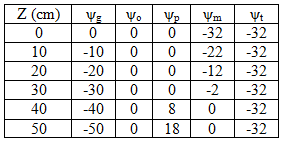
ψg is the distance of the point from the reference datum. Since it is downwards it is –ve. Since, there is no mention of contamination ψo is taken as zero at all points. ψp occurs only below water table. Water level is at 8 cm above 40 cm depth. Therefore, at 40 cm the ψp will be 8cm.At 30 cm its value will be zero since it is above water table. At 50 cm, the total height of water is 18 cm. Now the value of ψm is not known. But we know that below water table its value will be zero. Therefore, at 40 cm and 50 cm its value is 0. Therefore, the total potential (ψt) is known at 40 and 50 cm. It is the algebraic sum of all the water potentials. Therefore, it must be noted here that sign of the potential is very important. ψt at 40 cm and 50 cm is obtained as -32 cm. Since it is under hydraulic equilibrium (given), ψt at all the points have to be -32 cm. Once ψt at all the points are know, then ψm at all locations can be determined. For example, at 10 cm depth, ψm = [ψt-( ψg + ψm + ψp + ψo] will give -32 + 10 = -22 cm.
(a) Reference datum at water table
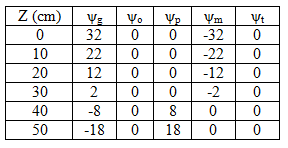
With the change in reference datum, ψg also changes. Due to this change, ψt also changes. The method of obtaining other potential remains same as in the previous case.
Problem: Assume water is evaporated from top soil and the matric potential is given for depth at 10 cm interval upto 50 cm. Water table is at a large depth greater than 50 cm. Determine total potential and direction of flow. Head is measured in cm. Distance downwards is taken negative. Reference datum is taken as ground surface.
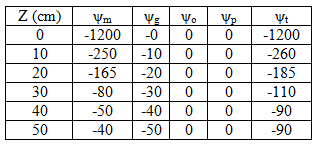
Since concentration is not mentioned and water table is at a depth larger than problem domain, both ψo and ψp will be zero at all points. Only ψg need to be determined. Between locations at 40 and 50 cm, there will be no flow occurring due to hydraulic equilibrium. From 40 cm depth, movement of water will occur upwards because water potential is low at the ground and high at 40 cm depth. Please note that the magnitude is high at the top (1200) but the potential is negative. This will draw or attract water towards that location.
Problem: A 10 cm tile drain with water height 2 cm is placed on clay layer at a depth of 40 cm from ground surface. Find component potential and total potential at 10 cm interval upto 50 cm depth. Determine the flow direction. Take reference datum at ground surface. Assume matric potential as one half of the distance to top of water table.
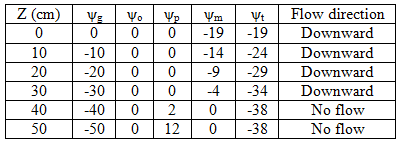
The above exercise shows that the flow of water takes place towards tile drain from ground surface. This is based on the values of total potential. Flow takes place from higher to lower potential. Please note that sign of the potential is very important.