In the absence of solutes, ψm can be expressed as follows (Scott 2000):
|
2.29 |
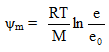
Where R is the universal gas constant (8.314 J/K.mol), T is the temperature in Kelvin, M is the mass of a mole of water in kg (0.018015), ψm is in J/kg, e is the vapour pressure of soil pore water, e0 is the vapour pressure of pure water at the same temperature. e is less than e0 due to the attraction of pore water on soil solids. The term e/ e0 is relative vapour pressure.
Problem: Relative vapour pressure at 20 °C is 0.85. Calculate ψm. If relative vapour pressure becomes 0.989 then what happens to ψm.
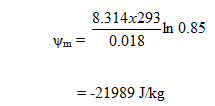
When relative vapour pressure is 0.989, then ψm = -1496 J/kg.
A higher relative vapour pressure is associated with high water content of the soil sample. From this example, it can be noted that as water content increases, matric suction reduces.
Solutes present in soil-water results in ψo due to the semi-permeable membrane effect produced by plant roots, air-water inter phase and clays. As concentration of solute increases, ψo also increases.
According to Vant-Hoff’s equation, ψo = RTCs 2.30
Where ψo is in J/kg, Cs is the concentration in mol/m3, R and T as defined earlier.
According to US Salinity laboratory, ψo = -0.056 TDS 2.31
Where TDS is the total dissolved solids of soil pore water in mg/L and ψo is in kPa.
Also, ψo = -36 EC 2.32
Where EC is the electrical conductivity of soil pore water in dS/m and ψo is in kPa.
sed as |
2.33 |

where ρw is the density of water in kg/m3, M is the mass of one mole of water (kg/mol), R and T as defined earlier, e is the equilibrium vapour pressure of soil pore water containing solutes, e0 is the vapour pressure of pure water in the absence of solute, and ψo is in kPa.
Problem: Calculate total potential of a saturated soil at 200C at a point through which reference datum passes. Saturated volumetric water content is 0.5. 1cm3 of soil at reference datum has 3x10⁻⁴ moles of solute. Water table is 1.2 m above reference datum.
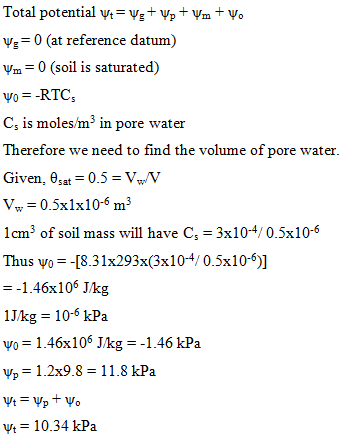
Note: It is important to put the sign for each of the potential.
Movement of water: Soil water moves from higher ψt to lower ψt. If we are concerned only about liquid flow, then the contribution of ψ0 is considered negligible because the solutes also move along with the flowing water. While considering flow of water, ψt can be rewritten as ψg + ψp + ψm. This total potential is termed as hydraulic potential causing flow. Under hydraulic equilibrium, ψt is same everywhere, spatially.