Quantification of soil-water
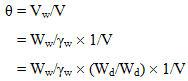
One of the main attributes that makes soil mechanics different from solid mechanics is the presence of water in the void spaces. The quality and quantity of water will significantly influence physical, chemical and engineering properties of soil such as plasticity, permeability, water retention, mass transport etc. The water present in the soil voids are quantified as water content, which is also referred to as capacity factor. Energy status of water is called intensity factor. Water content is further divided into gravimetric and volumetric water content. When water content is defined as the ratio of weight of water to the weight of soil solids (weight basis) it is termed as gravimetric water content, denoted as “w”. Volumetric water content is expressed as the ratio of volume of water (Vw) to the total volume of soil (V) and denoted by θ.
 |
2.23 |

 |
2.24 |
| Also, | 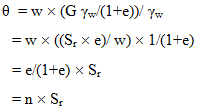 |
2.25 |
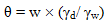
Where Ww is the weight of water, γw is the unit weight of water, Wd is the weight of dry soil, γd is the dry unit weight of soil, G is the specific gravity of soil, e is the void ratio, n is the porosity and Sr is the degree of saturation. Eqs. 2.24 and 2.25 relates θ with w and Sr, respectively. For a fully saturated soil, Sr = 1 and hence θ becomes equal to n.
There are some dimensionless expressions for water content, which are important for different modelling application. Some of the important expressions are given by Eqs. 2.26 and 2.27.
| Relative water content, θrel = θ /θsat | 2.26 |
| Reduced or effective water content, Se = (θ - θr) /θsa t- θr) | 2.27 |
Where θsat and θr are saturated volumetric water content and residual water content. The same expressions are valid in terms of gravimetric water content also.
Mechanical energy of water
Kinetic energy (KE) of water present in porous media is considered to be negligible due to the low flow velocity in moderate and low permeable soil. However, KE is important in granular soils where velocity is significant and also in the case of preferential flow in soils. Preferential flow is caused in soils due to the formation of macrocracks which is mostly attributed to the shrinkage cracks in soil, holes or burrows created by animals, cracks caused by the roots of plants etc. Water would find an easy path through these cracks and hence known as preferential path ways.
Potential energy (PE) is the most important energy component of water present in the porous media. It is the difference in PE between two spatial locations in soil that determines rate and direction of flow of water. The rate of decrease in PE is termed as hydraulic gradient (i). PE of water is termed as soil-water potential. The total soil-water potential (ψt) is the summation of different PE components as given by Eq. 2.28.
ψt = ψg + ψm + ψp + ψo |
2.28 |
Where ψg is the gravitational potential, ψm is the matric potential, ψp is the pressure potential and ψo is the osmotic potential.
ψg is due to the difference in elevation between two reference points and hence it is also known as elevation head (z). For this a reference datum position is always defined based on which elevation is measured.
The point above the datum is negative and below is positive. ψm is caused due to the adsorptive and capillary forces present in the soil. Such a force always retains water towards the soil surface and hence the potential is always taken as negative. ψp is the pressure potential below the ground water table and hence the potential is always positive. It is the head indicated by a piezometer inserted in the soil and hence it is termed as piezometric head or pressure head. Such a potential is valid for fully saturated state of the soil. However, saturation due to capillary rise is not considered since such water is held under tension. ψo is caused due to salts and contaminants (solutes) present in the soil pore water. Since the solute present in the water try to retain water molecules, ψo is always negative.