Now carrying out the linear interpolation between 12% and 14%;
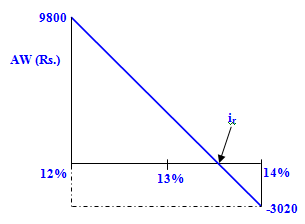
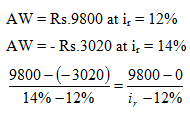
On solving the above expression, the value of ir is found to be 13.52% per year. The minor difference in the values of ir from present worth and annual worth methods is due to the effect of decimal points in the calculations. Similar to present worth and annual worth methods, the rate of return ‘ir’ can also be determined by equating the net future worth to zero.
From the above example, a unique value of rate of return was obtained for the construction equipment (on the basis of its cash inflow and cash outflow). This is due to the fact that, there was only one sign change in the cash flows i.e. minus sign at time zero for the cash outflow followed by plus sign for cash inflows during the remaining periods. However in some cases, depending upon the cash flow it is possible to get multiple values of rate of return, those satisfy the rate of return equation of the equivalent worth of cash inflows and cash out flows. This may happen due to more than one sign change in the cash flows e.g. cash outflow (negative) at beginning (time zero) followed cash inflows (positive) at end of year 1 and 2 and then cash outflow (negative) at end of year 3 etc. Thus while selecting an alternative that has multiple values of rate of return (depending on the cash flow), other method of economic evaluation may be adopted to find out the economical suitability of the alternative.