Now the above equation will be solved through trial and error process to find out the value of ir. Basically a positive value and a negative value of the net present worth will be determined at rate of return values close to the actual one and then by linear interpolation between these two values, the actual rate of return will be calculated. For finding out the rate of return values (close to the actual one), those will give a positive value and a negative value of net present worth, one has to carry out a number of trial calculations at various values of ir.
Since MARR is 10%, first assume a value of ir equal to 8% and compute the net present worth. Now putting the values of different compound interest factors in the expression for net present worth at ir equal to 8% results in the following;

PW = Rs.232054
The above calculated net present worth at ir equal to 8% is greater than zero, now assume a higher value of ir i.e. 12% for the next trial and compute the net present worth.

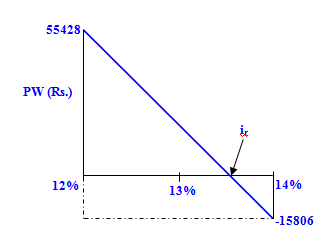
PW = Rs.55428
As observed from this calculation, the net present worth is decreased at higher value of ir. Thus for getting a negative value of net present worth, assume further higher value of ir than the previous trial and take 14% for the next trial and determine the net present worth.

PW = -Rs.15806
Since a negative value of net present worth at ir equal to 14% is obtained (as above), the actual value of rate of return is less than 14%. The actual rate of return is now obtained by doing linear interpolation either between 8% and 14% or between 12% and 14%. However for obtaining a more accurate value of rate of return, the linear interpolation is carried out between 12% and 14% and is given as follows;