The incremental B/C ratio analysis is illustrated in the following example.
Example -21
There are four mutually exclusive alternatives for a public project. Select the best alternative using incremental B/C ratio analysis if interest rate is 7% per year. The cash flow details of the alternatives are shown in the following table. Each alternative has the useful life of 40 years.
Table 2.7 Cash flow of alternatives for the project
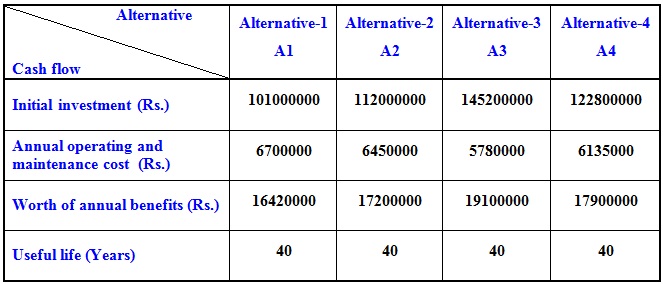
Solution:
First the conventional B/C ratio will be used for the incremental benefit-cost analysis for the comparison of above mutually exclusive alternatives. Present worth method will be used for the calculation of equivalent worth of benefits and costs.
In order to arrange the alternatives in the increasing order of equivalent cost, first the equivalent worth (present worth) of the costs of all the four alternatives are calculated.
Present worth of costs of Alternative-1 (A1):
PW of costs of A1 = 101000000 + 6700000(P/A, i, n)
PW of costs of A1 = 101000000 + 6700000(P/A, 7%, 40)
PW of costs of A1 = 101000000 + 6700000 X 13.3317
PW of costs of A1 = 190322390
Present worth of costs of Alternative-2 (A2):
PW of costs of A2 = 112000000 + 6450000(P/A, i, n)
PW of costs of A2 = 112000000 + 6450000(P/A, 7%, 40)
PW of costs of A2 = 112000000 + 6450000 X 13.3317
PW of costs of A2 = 197989465
Present worth of costs of Alternative-3 (A3):
PW of costs of A3 = 145200000 + 5780000(P/A, i, n)
PW of costs of A3 = 145200000 + 5780000(P/A, 7%, 40)
PW of costs of A3 = 145200000 + 5780000 X 13.3317
PW of costs of A3 = 222257226
Present worth of costs of Alternative-4 (A4):
PW of costs of A4 = 122800000 + 6135000(P/A, i, n)
PW of costs of A4 = 122800000 + 6135000(P/A, 7%, 40)
PW of costs of A4 = 122800000 + 6135000 X 13.3317
PW of costs of A4 = 204589980
As observed from the above calculations, the order of alternatives from lowest equivalent cost to highest equivalent cost is A1, A2, A4 and A3.