|
The purpose of the contraction joint is to allow the contraction of the slab
due to fall in slab temperature below the construction temperature.
The design considerations are:
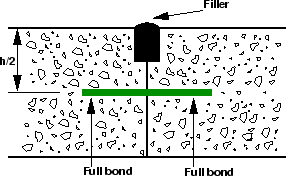
Figure 1:
Contraction joint
 |
The purpose of the dowel bar is to effectively transfer the load between two
concrete slabs and to keep the two slabs in same height.
The dowel bars are provided in the direction of the traffic (longitudinal).
The design considerations are:
- Mild steel rounded bars,
- bonded on one side and free on other side
|
|


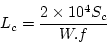
 is the allowable stress in tension in cement concrete and is taken
as 0.8 kg/cm
is the allowable stress in tension in cement concrete and is taken
as 0.8 kg/cm ,
,  is the unit weight of the concrete which can be taken as
2400 kg/cm
is the unit weight of the concrete which can be taken as
2400 kg/cm and
and  is the coefficient of sub-grade friction which can be
taken as 1.5.
is the coefficient of sub-grade friction which can be
taken as 1.5.