Temperature stresses are developed in cement concrete pavement due to variation
in slab temperature.
This is caused by (i) daily variation resulting in a temperature gradient
across the thickness of the slab and (ii) seasonal variation resulting in
overall change in the slab temperature.
The former results in warping stresses and the later in frictional
stresses.
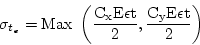
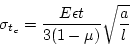
The warping stress at the interior, edge and corner regions, denoted as
in kg/cm respectively and given
by the equation 2-3.
(1)
(2)
(3)
where
is the modulus of elasticity of concrete in kg/cm (310),
is the thermal coefficient of concrete per C (110)
is the temperature difference between the top and bottom of the slab,
and are the coefficient based on in the desired direction
and right angle to the desired direction,
is the Poisson's ration (0.15),
is the radius of the contact area and
is the radius of the relative stiffness.


 in kg/cm
 respectively and given
by the equation
respectively and given
by the equation 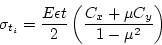
 is the modulus of elasticity of concrete in kg/cm
 10
10 ),
),
 is the thermal coefficient of concrete per
  C (1
C (1 )
)
 is the temperature difference between the top and bottom of the slab,
 and
and  are the coefficient based on
  in the desired direction
and
in the desired direction
and  right angle to the desired direction,
 is the Poisson's ration (0.15),
 is the radius of the contact area and
 is the radius of the relative stiffness.