|
Plate bearing test is used to evaluate the support capability of sub-grades,
bases and in some cases, complete pavement.
Data from the tests are applicable for the design of both flexible and rigid
pavements.
In plate bearing test, a compressive stress is applied to the soil or pavement
layer through rigid plates relatively large size and the deflections are
measured for various stress values.
The deflection level is generally limited to a low value, in the order of 1.25
to 5 mm and so the deformation caused may be partly elastic and partly plastic
due to compaction of the stressed mass with negligible plastic deformation.
The plate-bearing test has been devised to evaluate the supporting power of sub
grades or any other pavement layer by using plates of larger diameter.
The plate-bearing test was originally meant to find the modulus of sub grade
reaction in the Westergaard's analysis for wheel load stresses in cement
concrete pavements.
Test Procedure
- The test site is prepared and loose material is removed so that the 75 cm
diameter plate rests horizontally in full contact with the soil sub-grade.
The plate is seated accurately and then a seating load equivalent to a pressure
of 0.07 kg/cm2 (320 kg for 75 cm diameter plate) is applied and released after
a few seconds.
The settlement dial gauge is now set corresponding to zero load.
- A load is applied by means of jack, sufficient to cause an average
settlement of about 0.25 cm.
When there is no perceptible increase in settlement or when the rate of
settlement is less than 0.025 mm per minute (in the case of soils with high
moisture content or in clayey soils) the load dial reading and the settlement
dial readings are noted.
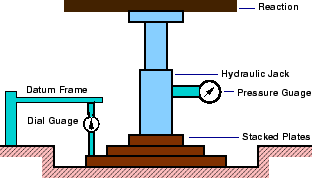
- Deflection of the plate is measured by means of deflection dials; placed
usually at one-third points of the plate near it's outer edge.
- To minimize bending, a series of stacked plates should be used.
- Average of three or four settlement dial readings is taken as the
settlement of the plate corresponding to the applied load.
Load is then increased till the average settlement increase to a further amount
of about 0.25 mm, and the load and average settlement readings are noted as
before.
The procedure is repeated till the settlement is about 1.75 mm or more.
- Allowance for worst subgrade moisture and correction for small plate size
should be dealt properly.
- Calculation
A graph is plotted with the mean settlement versus bearing pressure (load per
unit area) as shown in Figure 1.
The pressure corresponding to a settlement is obtained from this graph.
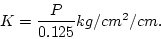
The modulus of subgrade reaction is calculated from the relation.
 |
(1) |
Figure 1:
Plate load test
 |
|
|

