|
California Bearing Ratio Test
California Bearing Ratio (CBR) test was developed by the California Division of
Highway as a method of classifying and evaluating soil-sub grade and base
course materials for flexible pavements.
CBR test, an empirical test, has been used to determine the material properties
for pavement design.
Empirical tests measure the strength of the material and are not a true
representation of the resilient modulus.
It is a penetration test wherein a standard piston, having an area of 3 in (or 50 mm diameter), is used to penetrate the soil at a standard rate of 1.25
mm/minute.
The pressure up to a penetration of 12.5 mm and it's ratio to the bearing value
of a standard crushed rock is termed as the CBR.
(or 50 mm diameter), is used to penetrate the soil at a standard rate of 1.25
mm/minute.
The pressure up to a penetration of 12.5 mm and it's ratio to the bearing value
of a standard crushed rock is termed as the CBR.
In most cases, CBR decreases as the penetration increases.
The ratio at 2.5 mm penetration is used as the CBR.
In some case, the ratio at 5 mm may be greater than that at 2.5 mm.
If this occurs, the ratio at 5 mm should be used.
The CBR is a measure of resistance of a material to penetration of standard
plunger under controlled density and moisture conditions.
The test procedure should be strictly adhered if high degree of reproducibility
is desired.
The CBR test may be conducted in re-moulded or undisturbed specimen in the
laboratory.
The test is simple and has been extensively investigated for field correlations
of flexible pavement thickness requirement.
Test Procedure
- The laboratory CBR apparatus consists of a mould 150 mm diameter with a
base plate and a collar, a loading frame and dial gauges for measuring the
penetration values and the expansion on soaking.
- The specimen in the mould is soaked in water for four days and the
swelling and water absorption values are noted.
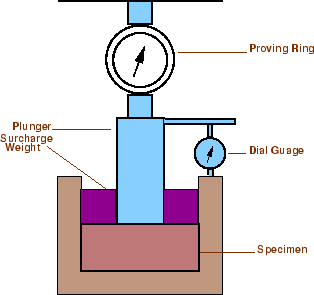
The surcharge weight is placed on the top of the specimen in the mould and the
assembly is placed under the plunger of the loading frame.
- Load is applied on the sample by a standard plunger with dia of 50 mm at
the rate of 1.25 mm/min.
A load penetration curve is drawn.
The load values on standard crushed stones are 1370 kg and 2055 kg at 2.5 mm
and 5.0 mm penetrations respectively.
- CBR value is expressed as a percentage of the actual load causing the
penetrations of 2.5 mm or 5.0 mm to the standard loads mentioned above.
Therefore,
- Two values of CBR will be obtained.
If the value of 2.5 mm is greater than that of 5.0 mm penetration, the former
is adopted.
If the CBR value obtained from test at 5.0 mm penetration is higher than that
at 2.5 mm, then the test is to be repeated for checking.
If the check test again gives similar results, then higher value obtained at
5.0 mm penetration is reported as the CBR value.
The average CBR value of three test specimens is reported as the CBR value of
the sample.
Figure 1:
CBR Test
 |
|


