|
The wide range of soil types available as highway construction materials have
made it obligatory on the part of the highway engineer to identify and classify
different soils.
A survey of locally available materials and soil types conducted in India
revealed wide variety of soil types, gravel, moorum and naturally occurring
soft aggregates, which can be used in road construction.
Broadly, the soil types can be categorized as Laterite soil, Moorum / red soil,
Desert sands, Alluvial soil, Clay including Black cotton soil.
Figure 1:
Indian standard grain size soil classification system
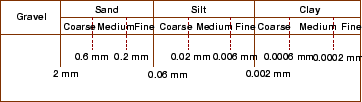 |
- Gravel: These are coarse materials with particle size under 2.36 mm
with little or no fines contributing to cohesion of materials.
- Moorum: These are products of decomposition and weathering of the
pavement rock. Visually these are similar to gravel except presence of higher
content of fines.
- Silts: These are finer than sand, brighter in color as compared to
clay, and exhibit little cohesion.
When a lump of silty soil mixed with water, alternately squeezed and tapped a
shiny surface makes its appearance, thus dilatancy is a specific property of
such soil.
- Clays: These are finer than silts.
Clayey soils exhibit stickiness, high strength when dry, and show no dilatancy.
Black cotton soil and other expansive clays exhibit swelling and shrinkage
properties.
Paste of clay with water when rubbed in between fingers leaves stain, which is
not observed for silts.
|
|

