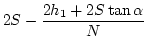
|
The length of the curve  is less than SSD.
In this case the minimum sight distance is from the beginning of the curve.
The important points are the beginning of the curve and the bottom most part of
the curve.
If the vehicle is at the bottom of the curve, then its headlight beam will
reach far beyond the endpoint of the curve whereas, if the vehicle is at the
beginning of the curve, then the headlight beam will hit just outside the
curve.
Therefore, the length of the curve is derived by assuming the vehicle at the
beginning of the curve .
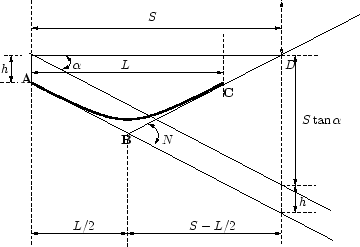
The case is shown in figure 1. is less than SSD.
In this case the minimum sight distance is from the beginning of the curve.
The important points are the beginning of the curve and the bottom most part of
the curve.
If the vehicle is at the bottom of the curve, then its headlight beam will
reach far beyond the endpoint of the curve whereas, if the vehicle is at the
beginning of the curve, then the headlight beam will hit just outside the
curve.
Therefore, the length of the curve is derived by assuming the vehicle at the
beginning of the curve .
The case is shown in figure 1.
From the figure,
Figure 1:
Valley curve, case 2, 
 |
Note that the above expression is approximate and is satisfactory because in
practice, the gradients are very small and is acceptable for all practical
purposes.
We will not be able to know prior to which case to be adopted.
Therefore both has to be calculated and the one which satisfies the condition
is adopted.
|


 )
)