|
There is no restriction to sight distance at valley curves during day time.
But visibility is reduced during night.
In the absence or inadequacy of street light, the only source for visibility is
with the help of headlights.
Hence valley curves are designed taking into account of headlight distance.
In valley curves, the centrifugal force will be acting downwards along with the
weight of the vehicle, and hence impact to the vehicle will be more.
This will result in jerking of the vehicle and cause discomfort to the
passengers.
Thus the most important design factors considered in valley curves are: (1)
impact-free movement of vehicles at design speed and (2) availability of
stopping sight distance under headlight of vehicles for night driving.
For gradually introducing and increasing the centrifugal force acting
downwards, the best shape that could be given for a valley curve is a
transition curve.
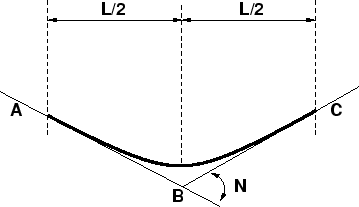
Cubic parabola is generally preferred in vertical valley curves. See
figure 1.
Figure 1:
Valley curve details
 |
During night, under headlight driving condition, sight distance reduces and
availability of stopping sight distance under head light is very important.
The head light sight distance should be at least equal to the stopping sight
distance.
There is no problem of overtaking sight distance at night since the other
vehicles with headlights could be seen from a considerable distance.
|

