|
 |
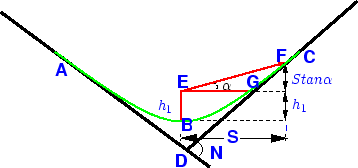
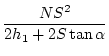
where  is the deviation angle in radians, is the deviation angle in radians,  is the height of headlight
beam, is the height of headlight
beam,  is the head beam inclination in degrees and is the head beam inclination in degrees and  is the sight
distance.
The inclination is is the sight
distance.
The inclination is  1 degree. 1 degree.
|
| Module 3: Geometric design of highways | |||||||||||||||||||||||||||||
| Lecture 18 Vertical alignment II | |||||||||||||||||||||||||||||
|
|||||||||||||||||||||||||||||
 )
) is greater than the stopping sight
distance SSD.
The sight distance available will be minimum when the vehicle is in the lowest
point in the valley.
This is because the beginning of the curve will have infinite radius and the
bottom of the curve will have minimum radius which is a property of the
transition curve.
The case is shown in figure
is greater than the stopping sight
distance SSD.
The sight distance available will be minimum when the vehicle is in the lowest
point in the valley.
This is because the beginning of the curve will have infinite radius and the
bottom of the curve will have minimum radius which is a property of the
transition curve.
The case is shown in figure