Text_Template
Module 3: Geometric design of highways
Lecture 15 Horizontal alignment II
1
2
3
4
5
6
7
8
9
10
11
Solution
Assumptions
The ruling design speed for NH passing through a rolling terrain is 80 kmph. The coefficient of lateral friction
=0.15. The maximum permissible super elevation
=0.07.
Case: Radius = 450m
Step 1
Find
for 75 percent of design speed, neglecting
, i.e
.
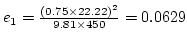
Step 2
. Hence the design is sufficient.
Answer: Design superelevation: 0.06.
Case: Radius = 150m
Step 1
Find
for 75 percent of design speed, neglecting
, i.e
.
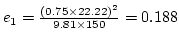
Max.
to be provided =
Step 3
Find
for the design speed and max
, i.e
.
Step 4
Find the
allowable speed
for the maximum
and
,


 =0.15.
The maximum permissible super elevation
=0.15.
The maximum permissible super elevation  =0.07.
 .
.

 . Hence the design is sufficient.
 Max.
Max.
 for the design speed and max
  .
.
 for the maximum
  and
and
 ,
,
