|
The reasons for the mechanical widening are:
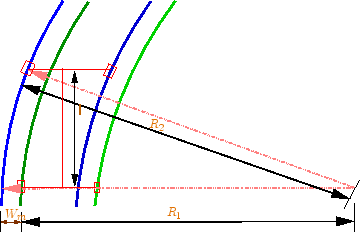
When a vehicle negotiates a horizontal curve, the rear wheels follow a path of
shorter radius than the front wheels as shown in figure 4.
This phenomenon is called off-tracking, and has the effect of increasing the
effective width of a road space required by the vehicle.
Therefore, to provide the same clearance between vehicles traveling in
opposite direction on curved roads as is provided on straight sections, there
must be extra width of carriageway available.
This is an important factor when high proportion of vehicles are using the
road.
Trailor trucks also need extra carriageway, depending on the type of joint.
In addition speeds higher than the design speed causes transverse skidding
which requires additional width for safety purpose.
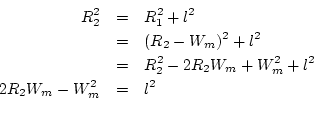
The expression for extra width can be derived from the simple geometry of a
vehicle at a horizontal curve as shown in figure 4.
Let  is the radius of the outer track line of the rear wheel, is the radius of the outer track line of the rear wheel,
 is the radius of the outer track line of the front wheel is the radius of the outer track line of the front wheel
 is the distance between the front and rear wheel, is the distance between the front and rear wheel,
 is the number of lanes, then the mechanical widening is the number of lanes, then the mechanical widening  (refer
figure 1) is derived below: (refer
figure 1) is derived below:
Therefore the widening needed for a single lane road is:
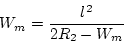 |
(1) |
If the road has lanes, the extra widening should be provided on each lane.
Therefore, the extra widening of a road with lanes is given by,
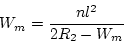 |
(2) |
Please note that for large radius,  , which is the mean radius of
the curve,then is given by: , which is the mean radius of
the curve,then is given by:
 |
(3) |
Widening of pavements has to be done for some psychological reasons also.
There is a tendency for the drivers to drive close to the edges of the pavement
on curves.
Some extra space is to be provided for more clearance for the crossing and
overtaking operations on curves.
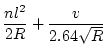
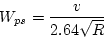
IRC proposed an empirical relation for the psychological widening at horizontal
curves  : :
 |
(4) |
Therefore, the total widening needed at a horizontal curve  is: is:
Figure 1:
Extra-widening at a horizontal curve
 |
|
|