|
While designing the various elements of the road like superelevation, we design
it for a particular vehicle called design vehicle which has some standard
weight and dimensions.
But in the actual case, the road has to cater for mixed traffic.
Different vehicles with different dimensions and varying speeds ply on the
road.
For example, in the case of a heavily loaded truck with high centre of gravity
and low speed, superelevation should be less, otherwise chances of toppling are
more.
Taking into practical considerations of all such situations, IRC has given some
guidelines about the maximum and minimum superelevation etc.
These are all discussed in detail in the following sections.
For fast moving vehicles, providing higher superelevation without considering
coefficient of friction is safe, i.e. centrifugal force is fully counteracted
by the weight of the vehicle or superelevation.
For slow moving vehicles, providing lower superelevation considering
coefficient of friction is safe, i.e.centrifugal force is counteracted by
superelevation and coefficient of friction .
IRC suggests following design procedure:
- Step 1
- Find
 for 75 percent of design speed, neglecting for 75 percent of design speed, neglecting  , i.e , i.e
 . .
- Step 2
- If
 , then , then
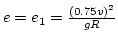 , else if , else if
 go to step 3. go to step 3.
- Step 3
- Find
 for the design speed and max , i.e for the design speed and max , i.e
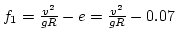 .
If .
If  , then the maximum , then the maximum  is safe for the design speed, else go
to step 4. is safe for the design speed, else go
to step 4.
- Step 4
- Find the allowable speed
 for the maximum and for the maximum and
 , ,
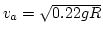 If
If  then the design is adequate, otherwise use speed adopt control
measures or look for speed control measures. then the design is adequate, otherwise use speed adopt control
measures or look for speed control measures.
|
|

