| |
| | |
|
To conduct operational analysis of signalized intersection, no. of input
parameters are required.
The data needed are detailed and varied and fall into three main categories:
geometric, traffic, and signalization.
Table 1:
Input data needs for each analysis of lane group
| Condition |
Parameter |
| Geometric |
Area type |
| |
Number of lanes, N |
| |
Average lane width, W (m) |
| |
Grade, G (%) |
| |
Existence of exclusive LT or RT lanes |
| |
Length of storage bay, LT or RT lane, L s (m) |
| |
Parking |
| Traffic |
Demand volume by movement, V (veh/h) |
| |
Base saturation flow rate, s o (pc/h/ln) |
| |
Peak-hour factor, PHF |
| |
Percent heavy vehicles, HV (%) |
| |
Approach pedestrian flow rate, vped (p/h) |
| |
Local buses stopping at intersection, NB (buses/h) |
| |
Parking activity, Nm (maneuvers/h) |
| |
Arrival type, AT |
| |
Proportion of vehicles arriving on green, P |
| |
Approach speed, S A (km/h) |
| Control |
Cycle length, C (s) |
| |
Green time, G (s) |
| |
Yellow-plus-all-red change-and-clearance interval |
| |
(inter green), Y (s) |
| |
Actuated or pre-timed operation |
| |
Pedestrian push-button |
| |
Minimum pedestrian green, Gp (s) |
| |
Phase plan |
| |
Analysis period, T (h) |
Intersection geometry is generally presented in diagrammatic form and must
include all of the relevant information, including approach grades, the number
and width of lanes, and parking conditions.
Traffic volumes (for oversaturated conditions, demand must be used) for the
intersection must be specified for each movement on each approach.
In situations where the v/c is greater than about 0.9, control delay is
significantly affected by the length of the analysis period.
- If v/c exceeds 1.0 during the analysis period, the length of the analysis
period should be extended to cover the period of oversaturation in the same
fashion, as long as the average flow during that period is relatively constant.
- An important traffic characteristic that must be quantified to complete
an operational analysis of a signalized intersection is the quality of the
progression.
The parameter that describes this characteristic is the arrival type, AT, for
each lane group.
| AT |
Description |
| 1 |
Dense platoon- 80% arrived at start of red |
| 2 |
Moderately dense- 40-80% arrived during red |
| 3 |
Less than 40% (highly dispersed platoon) |
| 4 |
Moderately dense, 40-80% arrived during green |
| 5 |
Dense to moderately dense- 80% arrive at start of green |
| 6 |
Very dense platoons progressing over a no. of closed space I/S |
The arrival type should be determined as accurately as possible because it will
have a significant impact on delay estimates and LOS determination.
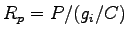
It can be computed as
 |
(1) |
where,  = platoon ratio, P = proportion of all vehicles in movement
arriving during green phase, C = cycle length (s) and = platoon ratio, P = proportion of all vehicles in movement
arriving during green phase, C = cycle length (s) and  = effective green
time for movement or lane group (s). = effective green
time for movement or lane group (s).
Complete information regarding signalization is needed to perform an analysis.
This information includes a phase diagram illustrating the phase plan, cycle
length, green times, and change-and-clearance intervals.
If pedestrian timing requirements exist, the minimum green time for the phase
is indicated and provided for in the signal timing.
The minimum green time for a phase is estimated as,
where,  = minimum green time (s), L = crosswalk length (m), = minimum green time (s), L = crosswalk length (m),  =
average speed of pedestrians (m/s), =
average speed of pedestrians (m/s),  = effective crosswalk width (m), 3.2
= pedestrian start-up time (s), and = effective crosswalk width (m), 3.2
= pedestrian start-up time (s), and  = number of pedestrians crossing
during an interval (p). = number of pedestrians crossing
during an interval (p).
|
|
| | |
|
|
|



