3.10.5. Biological Activity of Rashel's Pyrimidine Based Enediyne
ompounds A and B cleave double-stranded DNA which is shown in Figure 10 Both of them showed this property when incubating with ΦX174 dsDNA for 70 h at 40°C. The ketone B showed significant DNA nicking (Form II) at concentrations as low as 40 μM and nearly complete nicking at 4 mM. The alcohol A showed almost no reactivity at 40 μM but was able to nick DNA at 4 mM. While no double-strand (ds) cleavage (Form III) was observed at the lower concentrations, both A and B show slight ds cleavage at 4 mM.
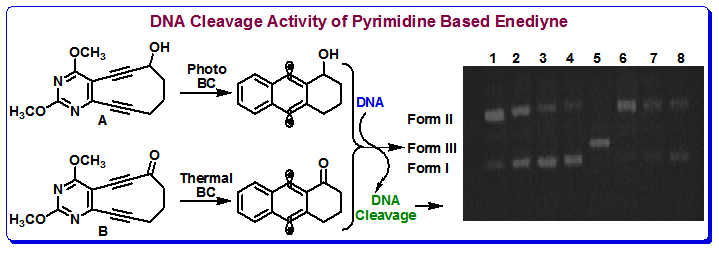
Figure 10. Supercoiled DNA interaction ΦX174. DNA was incubated for 70 h at 40°C with compounds A and B in buffer (TE, pH 7.6) and analyzed by electrophoresis (1% agarose gel, ethinium bromide stain). Lanes 1−3: A (4000, 400, and 40 μM); Lane 4: DNA control; Lane 5: DNA control + restriction enzyme, Dra I; Lanes 6−8: B (4000, 400, and 40 μM).
Photochemical DNA cleavage ability was also demonstrated for A and B (hν, 40°C, 3 h). In this case, compound A showed superior DNA cleavage ability. At 40 μM, compound B showed significant DNA single-strand cleavage. But, compound B showed no discernible activity. At higher concentrations (4000 μM), both compounds showed signs of double-strand scission, again with A giving the more complete reaction.
Compounds A and B both showed anticancer activity against human leukemic lymphoblasts of the CCRF-CEM cell line (log-phase cultures) (IC 50 values of ≈1.25 μM).