3.10. 2. Biological Activity of Basak's Azo Bispropargyl Sulfones
The amino enediyne shown in the figure below which is an intermediate for the synthesis of Basak's β-lactam-fused enediyne by the carbene insertion route, is able to cleave double strand DNA at a pH of 8.0. Both the double-strand cut (linear form) as well as the nicked form was seen using pBR 322 plasmid in micromolar concentrations range (Figure 6A). Only the nicked form of cleaved DNA was seen at similar concentrations while pBlueScript SK+ plasmid DNA was used (Figure 6B). The protonated form was proposed as the DNA-damaging agent. The positively charged nitrogen is able to withdraw electrons from the enediyne π- framework leading to lowering the activation barrier for the generation of benzene diradical via BC. It is also important to note that the perturbation of the singlet−triplet barrier in the diradical via through-bond or through-space could also be responsible for such DNA cleavage activity. It was also demonstrated that the protonated amine in the form of tosylate salt also undergoes BC at 30°C with a half-life of ~30 days.
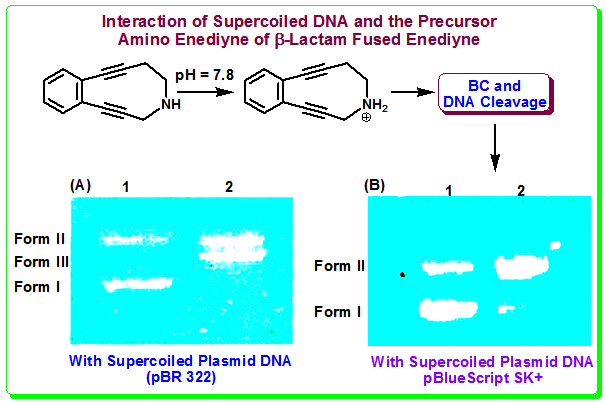
Figure 6. Interaction of supercoiled plasmid DNA (A) pBR 322 and (B) pBlueScript SK+ in Tris-acetate buffer at pH 8.0 and enediyne shown in acetonitrile. Agarose (0.7%) gel electrophoresis using ethidium bromide stain- Lane 1: DNA; Lane 2: DNA + enediyne (50 μmol).
3.10.2. Biological Activity of Basak's Azo Bispropargyl Sulfones
The cyclic Z-azo-bispropargyl sulfone showed higher DNA-cleavage efficiency ( ~2.5 times) than the corresponding E isomer presumably via the Garratt−Braverman pathway (Figure 7).
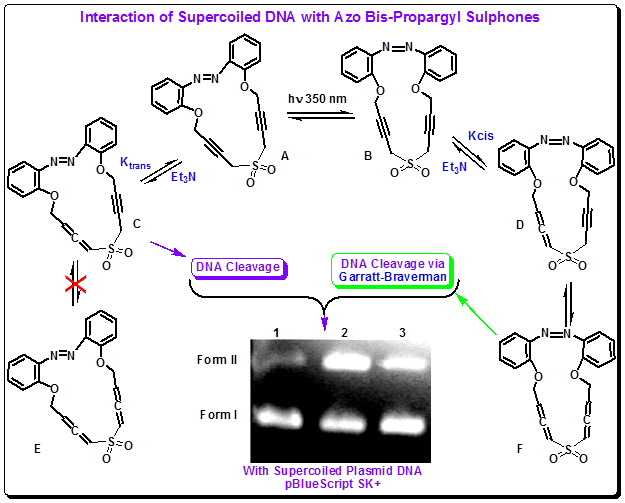
Figure 7. DNA-cleavage experiment of compounds A and B in TAE buffer (pH 8.5) with 7 μL DNA of 0.4 μm/bp concentration. Lane 1: control DNA + CH3 CN (10 μL); Lane 2: DNA + Z -sulfone B (0.02 mM) in 5 μL CH3 CN; Lane 3: DNA + E -sulfone A (0.02 mM) in 5 μL CH3 CN.