3.10.3. Biological Activity of Basak's Unsaturated Azo Bispropargyl Sulfones
A similar increase in DNA-cleavage activity of a related sulfone with an extra conjugation was also observed for the Z isomer as compared to the E analogue ( Figure 8 ).
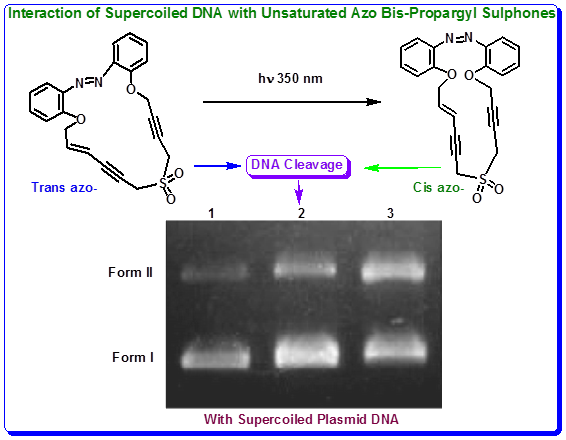
Figure 8. DNA-cleavage experiment of trans- and cis- unsaturated azo-bis-propargyl sulphone in TAE buffer (pH 8.5), and 7 μL of plasmid DNA (0.4 μm/bp). Lane 1: control DNA + CH3 CN (10 μL); Lane 2: DNA + E-sulfone (0.02 mM) in 5 μL CH3 CN; Lane 3: DNA + Z-sulfone (0.02 mM) in 5 μL CH3 CN.
3.10.4. Biological Activity of Popik's In-situ Generated Enediyne
An evaluation of the photogenerated nine-membered ring enediyne B , towards nuclease activity was carried out using supercoiled plasmid DNA cleavage assays. Three forms of this DNA: native (RF I), circular relaxed (RF II, produced by single-strand cleavage), and linear (RF III, formed by scission of both strand in close proximity) are readily separated by the agarose gel electrophoresis. Aqueous solution (5 mM) of cyclopropenone A was irradiated with low-pressure mercury lamp to produce reactive enediyne B . A solution of φX174 supercoiled circular DNA (10 ng/μL) in TE buffer was added to photolysate and incubated for 16 h at 25°C.
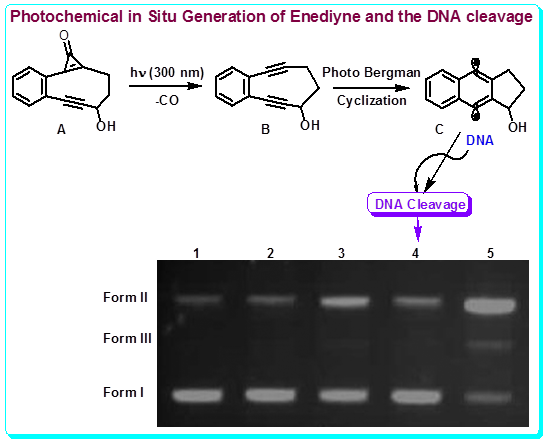 |
Figure 9. Cleavage of φX174 plasmid DNA by the photogenerated enediyne B . Lane 1: DNA alone; Lane 2 and 4: DNA + cyclopropenone precursors A in Dark; Lane 3 and 5: DNA + irradiated solution of A. (Pandithavidana, D. R.; Poloukhtine, A.; Popik, V. V. J. Am. Chem. Soc. 2009 , 131 , 351.).
Incubation of the DNA with cyclopropenone precursor A (lanes 2 and 4, Figure 9) does not induce any detectable DNA cleavage. The photogenerated enediyne B , on the other hand, induces substantial single strand cleavage of φX174 DNA (RF II), while linearized form (RF III) becomes prominent only at higher (5 mM) concentration of the cleaving agent (lanes 3 and 5 , Figure 9). Integration of fluorescence of bands on the gel shown in Figure 9, allowed the authors to evaluate the relative abundance of the native, circular, and linearized forms of φX174 DNA. Thus, incubation of the DNA with the 1 mM of enediyne B produces 45% of single strand cleavage (RF II) and less than 5% of the double strand cleavage (RF III, lane 3, Figure 9). At 5 mM concentration of B, DNA-cleavage efficiency increases to 67% and 10%, respectively (lane 5, Figure 9).