2.2.3. The Chromoprotein Types Enediyne Class
2.2.3.1. Neocarzinostatin Chromophore (NCS)
NCS is the first enediyne antibiotic that was first isolated from a culture of Streptomyces carzinostaticus var. F-41 in 1965. Its potent antibacterial and antitumor activities derived from the inhibition of DNA synthesis and DNA degradation in cells. It is composed of a very unstable chromophore and a carrier apoprotein. The neocarzinostatin core is slightly different from the basic enediyne structure. It contains the bicyclo[7.3.0]dodecenediyne and shows its biological activity through the involvement of the allene eneyne system. Meyer-Saito cyclization (MSC) is believed as the key step in the mechanism of action of the antitumor agent neocarzinostatin chromophore through which it produced a 3, 7-dehydroindene derivative as shown below (Scheme 4). The generated 
 - biradical via MSC is responsible to abstract H-atom from DNA backbone leading to the damage of DNA.
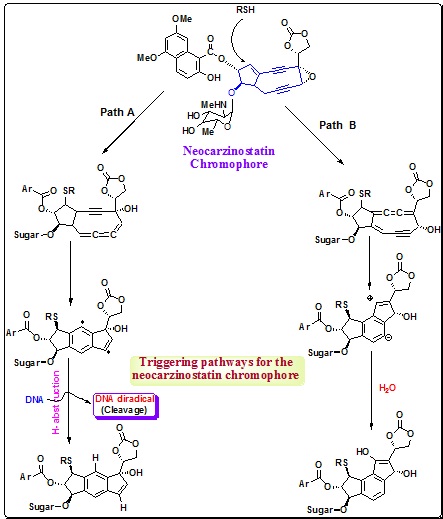 |
Scheme 4. Mechanism of DNA cleavage by Neocarzinostatin (zinostatin). |
The new antibiotic N1999A2 isolated from the broth filtrate of Streptomyces sp. AJ9493, possesses a novel 9-membered ring enediyne chromophore similar to neocarzinostatin. But N1999A2 is not chromoprotein. The most interesting feature is that the stable N1999A2 exists as enediyne chromophore alone. The antibiotic N1999A2, the structure of which is given below (Figure 4.), revealed more random DNA cutting profile than neocarzinostatin chromophore.
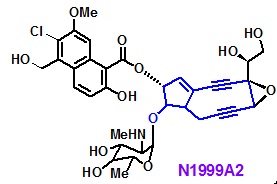 |
Figure 4. Structure of enediyne antibiotic N1999A2. |
2.2.3.2. C-1027 Chromophore
C-1027 is one of the most potent antitumor antibiotic chromoproteins. It composed of an 11-kDa apoprotein and a highly reactive chromophore. The C-1027 chromophore is in equilibrium with its active biradical form in the apoprotein and unlike NCS does not need nucleophiles or radicals for its activation. The p-benzyne biradical thus generated exerts its potent biological activity by abstracting hydrogen atoms from the sugar portion of double stranded DNA, which ultimately leads to oxidative cleavage of DNA (Scheme 5).
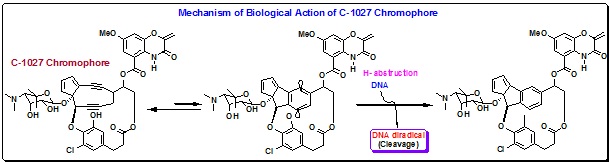 |
Scheme 5. Cycloaromatization process of C-1027 chromophore. |