2.2. Mechanism of DNA Cleavage
2.2.1. Calicheamicins and Esperamicins
The Calicheamicins (also known as the LL-E 33288 antibiotics) produced from Micromonospora echinospora spp. Calichensis, abacterium was discovered by May. D. Lee et al., in 1987. It is the most important member of the enediyne class of natural products, and possesses potent cytotoxicity against murine tumor cells.
Esperamicin A1 is also another member of the enediyne family of antibiotics exhibiting activity against marine tumor models in the 100ng/kg range. The families of Esperamicins were isolated from the bacterial Actinomadura verrucosospora and their structure elucidation was reported in 1987-89. The antitumor antibiotic drugs, calicheamicin, dynemicin, and esperamicin, all possessed bicyclo-[7,3,1]-enediyne substructure and become active p-benzyne biradical intermediates due to Bergman cyclizations. Precisely the reactive intermediate is proposed to be a 1, 4-dehydrobenzene derivative which is suggested to arise thermally from (Z)-enediyne in a cyclic version of the Bergman reaction.
The mechanistic studies have revealed that at a minimum, three common features are essential to the show the potent DNA cleavage activity by these antibiotics:
(a) non-destructive high-affinity binding to DNA,
(b) a chemical trigging mechanism leading to a high–energy intermediate
(c) rapid formation of biradical specis at physiological temperatures which is mainly responsible for DNA strand scission.
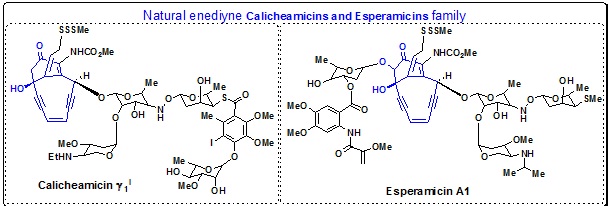 |
Figure 2. Structures of Calicheamicin |
 and Esperamicin A1.
The esperamicins and the calicheamicins both share similar structures and their structures possess three distinct domains: (a) an oligosaccharide chain, (b) a trisulphide moiety, and (c) an enediyne core. Each of these domains has a specific function in DNA cleavage.
(a) The oligosaccharide chain recognises and targets selected base pair sequences in the minor groove of DNA. Thus, the molecule binds selectively to the minor groove through hydrophobic, electrostatic interactions and hydrogen bonding of the sugar side chain with DNA. The natural enediynes are actually stable until they are bonded to DNA and then become activated.
(b) After binding to minor groove, the trisulphide then serves as a molecular trigger which upon reductive activation produces thiolate. The thiolate then performs an intramolecular Michael addition onto the proximally positioned enone moiety to unlock the enediyne warhead. This leads a change in the geometry of the molecule from a trigonal bridgehead to a tetragonal centre. Thus, “cd” distance between the two triple bonds is reduced. The decrease has been calculated to be from 3.35 to 3.16 Å distance which is close enough for spontaneous Bergman cyclization according to Nicolaou’s theory.
(c) Bergman cycloaromatization of the enediyne structural motif generates a p-benzyne diradical which abstracts hydrogen from DNA backbone. The reaction of the DNA backbone radicals with molecular oxygen results in double strand cleavage which ultimately lead to permanent damage of the genetic material.
The enediyne systems in both the calicheamicin and esperamicin could easily be triggered to aromatize via a free-radical intermediate by cleavage at the methyl trisulfide moiety. This aromatization process is responsible for the remarkable DNA damaging effects of the calcheamicin and the esperamicins.
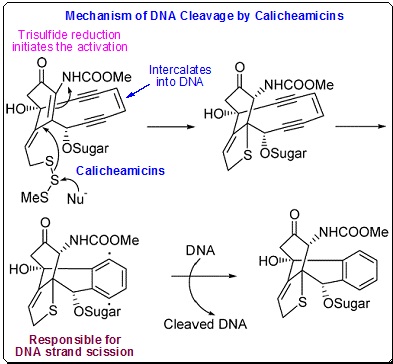 |
Scheme 1. Mechanism of DNA cleavage by Calicheamicin. |