2.2.2. Dynemicins
Dynemicin A (DNY-A) is the first known member of the family dynemicin A 1.187. It was isolated from Micromonospora chersina M956-1109 strain and the recent member deoxydynemicin A 1.187b was obtained from Micromoonspora globosa MG331-HF6. Dynemicin contain a bicyclo[7.3.1]enediyne substructure which may be related biosynthetically to the cores of calicheamicin and esperamicin. The dynemicins has a striking hybrid structure that contains (a) the cyclic enediyne, (b) an anthraquinone chromophore. Unlike the other members of this class, it exhibits antibacterial and antitumor activity with low toxicity. As a result of their intriguing and unique structural characteristics, various strategies have been developed to provide a synthetic route towards the natural and the non-natural dynemicin and its analogues.
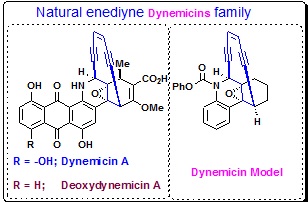 |
Figure 3. Structures of natural Dynemicin A and its model compound. |
Nicolaou et al., reported the synthesis of the dynemicin model compound (Figure 3) to demonstrate the mechanism of cyclization reactions of dynemicin A. In this model the critical distance (cd) was found to be 3.59 Å (popularly known as cd distance), a value that agrees with the X-ray crystallographic analysis of dynemicin A (3.54 A).
The mechanism of the cyclization reaction is as below (Scheme 2):
(a ) Protonation of the epoxide group initiates the formation of diol
(b) Spontaneous Bergman cyclization to form benzenoid biradical.
(c) Rapid trapping of the biradical by the hydrogen donor present to give the cyclized product.
This cyclization is analogous to those observed for dynemicin A. The pharmacological activity of this model compound is believed to be related to dynemicin A’s ability to cleave DNA following its intercalation into DNA with its anthraquinone which in actual fact is typical of most enediyne cyclization reactions. It is the benzenoid biradical that is actually responsible for the cleavage of the DNA molecule as illustrated in the scheme below, (Scheme 3).
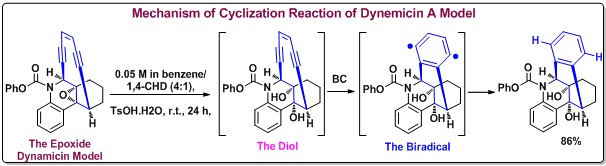 |
Scheme 2. Mechanism of the cyclization reaction of a dynemicin model compound. |
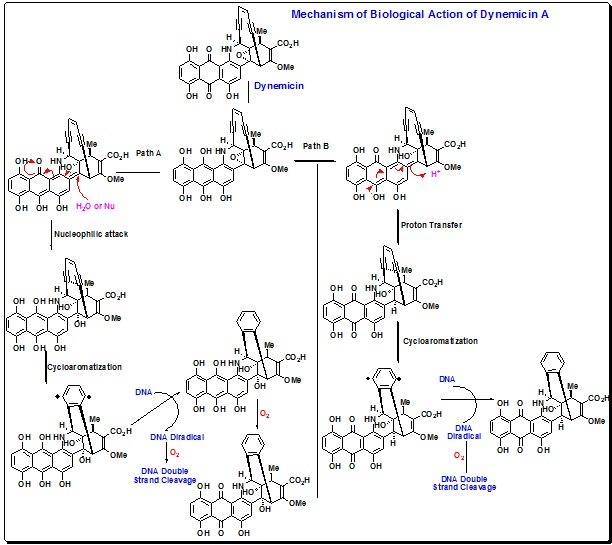 |
Scheme 3. Mechanism of biological action of dynemicin A. |